Go Beyond Symptoms. Find What Is Driving The Problem.
The OCI Assessment is a deeper organizational diagnostic for healthcare leaders who need to understand what is driving decision congestion, coordination drag, visibility problems, escalation strain, and uneven execution.
Deep organizational diagnostic · Executive interpretation · Baseline for comparison
The patterns behind leadership coordination strain:
Decisions that repeatedly recirculate
Important information arriving too late
Weak follow-through across leadership priorities
Workarounds or friction that remain hidden
Escalations that move without reaching closure
Leadership capacity being stretched by simultaneous change
“Operational coherence, the ability to maintain clear decisions, visibility, coordinated action, and learning under pressure, comes from architecture, not heroic effort.”
What The Assessment Examines
Read the Leadership Control Architecture™ across all Six Control Points.
The OCI Assessment interprets patterns across the Six Control Points rather than treating a single survey answer as a diagnosis.
01Decision Spine
Who decides, acts, and verifies.
02Execution Cadence
A leadership rhythm for priorities and commitments.
03Visibility Layer
The signals leaders need to see the real condition.
04Friction Radar
Early warning of workarounds and barriers.
05Command Core
Cross-functional authority when issues need closure.
06Leader System
The routines and capacity leaders need to sustain the work.
How It Works
Frame the operating question, diagnose the deeper pattern, and set a baseline for comparison.
1
Clarify the operating problem, the decisions that are getting stuck, and the leadership question that needs an answer.
2
Use the OCI Assessment to examine patterns across decision flow, coordination, escalation, visibility, and follow-through.
3
Use the executive narrative, priority risks, strengths, and improvement priorities to choose the next useful intervention.
Intended Use
Use OCI to establish a directional leadership baseline.
OCI helps leaders frame the executive conversation and identify where to investigate next. It is a structured source of leadership perspective, not a final verdict on the organization, its people, or its outcomes.
OCI is intended to:
Gather leadership perceptions.
Identify recurring architectural patterns.
Reveal meaningful perception gaps.
Support executive discussion and investigation.
Establish a directional baseline.
Help prioritize further assessment or improvement.
OCI is not intended to:
Determine objective organizational truth by itself.
Evaluate individual job performance.
Select, promote, discipline, or terminate employees.
Predict specific clinical, financial, safety, or workforce outcomes.
Replace interviews, operating data, or document review.
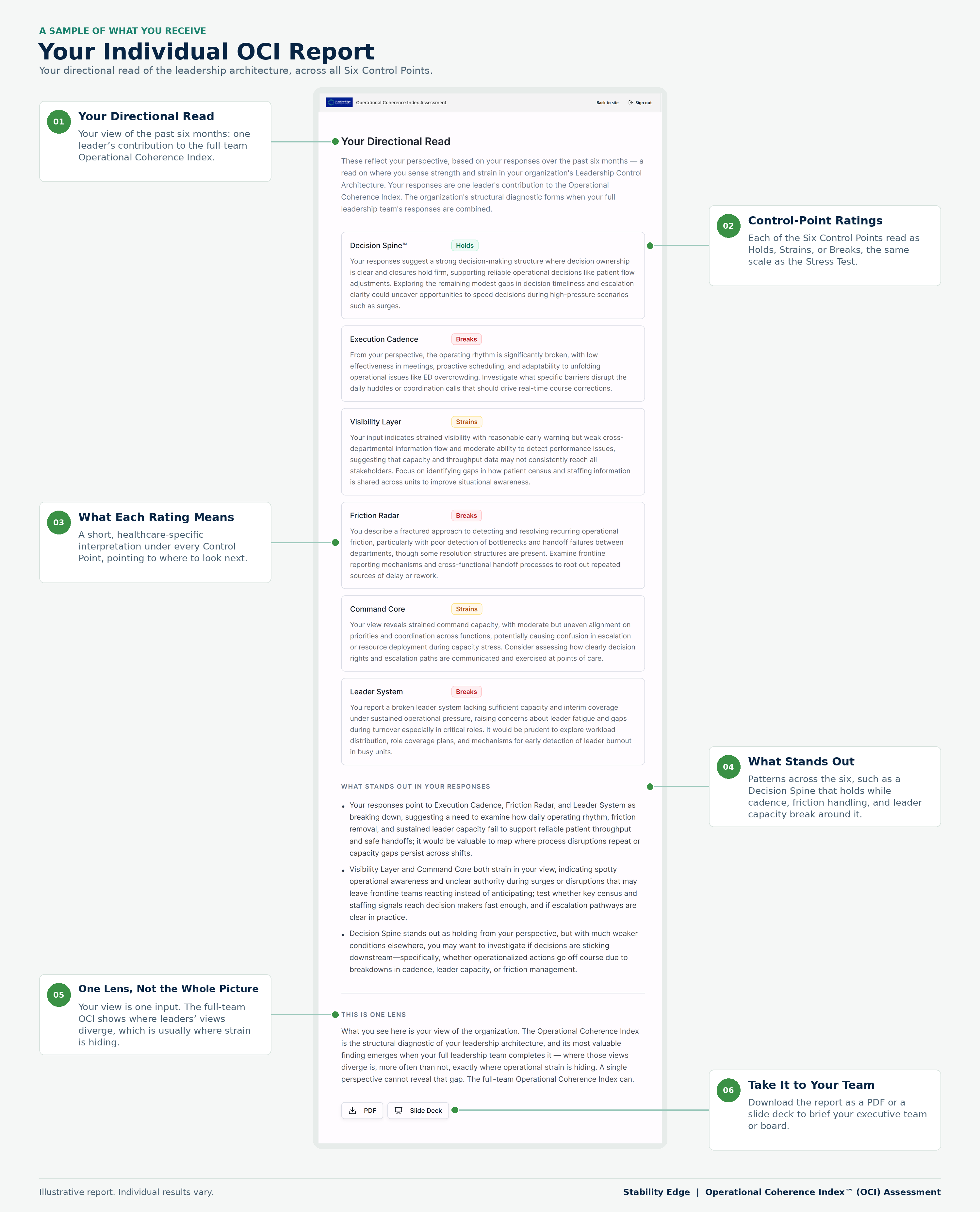
Individual OCI Sample Report
See what your individual OCI report includes.
Your directional read across the Six Control Points, control-point ratings, and observations from your responses. This is one leader’s perspective, not a score or an organizational diagnosis. Comparing perspectives with your team provides the fuller picture.
Explore a fictional Cresta Health System example, including control-point patterns, executive narrative, and improvement priorities.
Earlier scored example: This July 2026 sample includes numerical scores from an earlier report format. It is provided for reference and does not represent the current report format.
Cresta Health System is a fictional name. This report does not describe a client or a client result.
Opens the individual assessment in a new tab. To discuss an executive-team assessment, contact Stability Edge.
Informed by the Stability Operating System™. The OCI Assessment interprets evidence across the Six Control Points and supports executive interpretation, not a single-score verdict.