Why perspectives differ in healthcare transformation
During an EHR implementation, AI deployment, restructuring, merger integration, or enterprise workflow redesign, no leadership layer sees exactly the same work. Executives see enterprise priorities, investment decisions, milestones, and aggregate performance. Operational leaders see handoffs, bottlenecks, and trade-offs that keep services moving. Clinical and frontline leaders see the effort required to make the new process work safely for patients and staff.
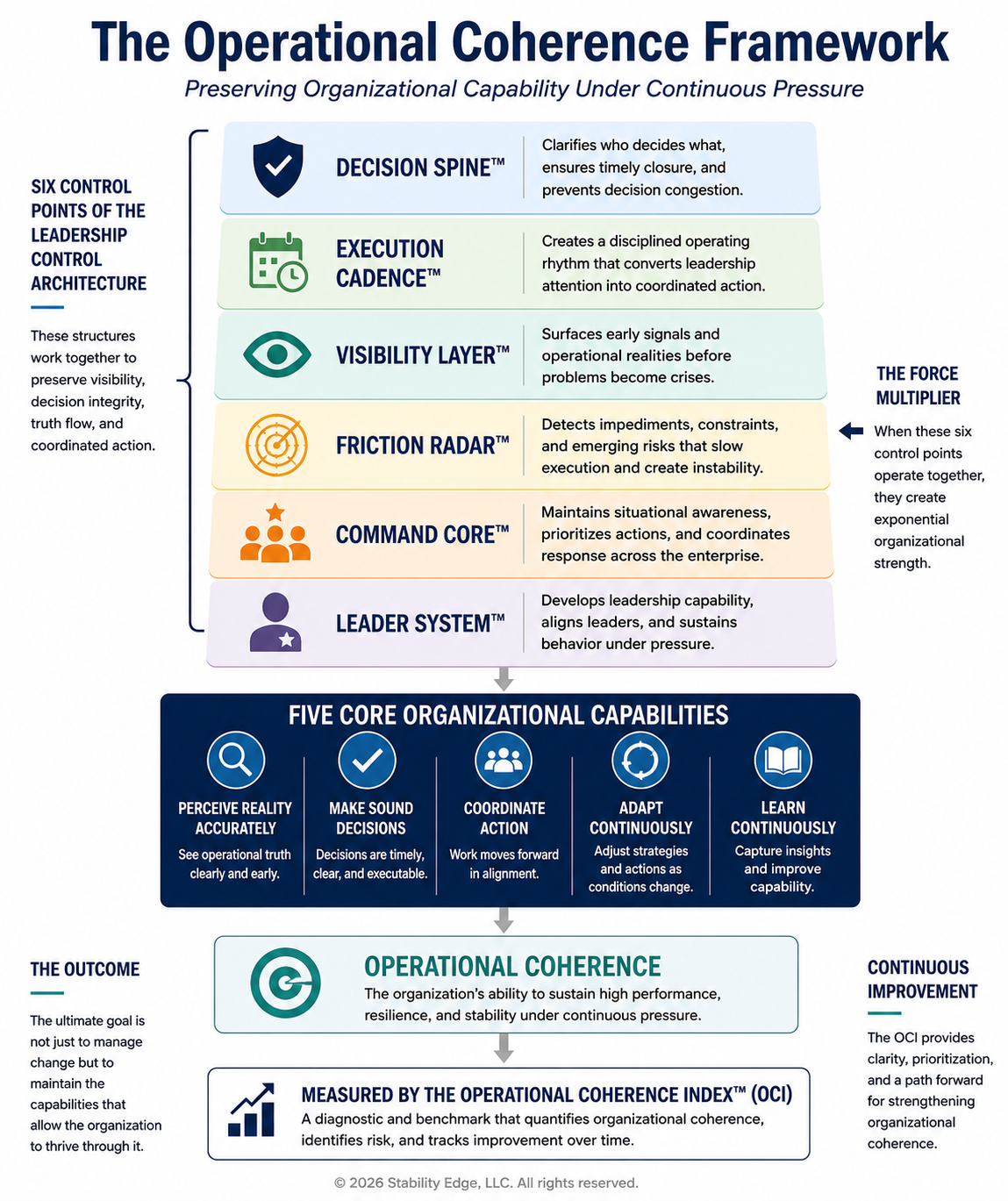
Different views are not the problem. The risk begins when the organization treats one view as the whole reality. A leadership team can appear aligned in a formal meeting while managers are navigating conflicting priorities, frontline teams are absorbing workarounds, and issues are taking too long to reach a decision-maker. That is not simply a communication problem or a technology problem. It is a leadership architecture problem: a problem in how the organization sees, decides, escalates, and coordinates.
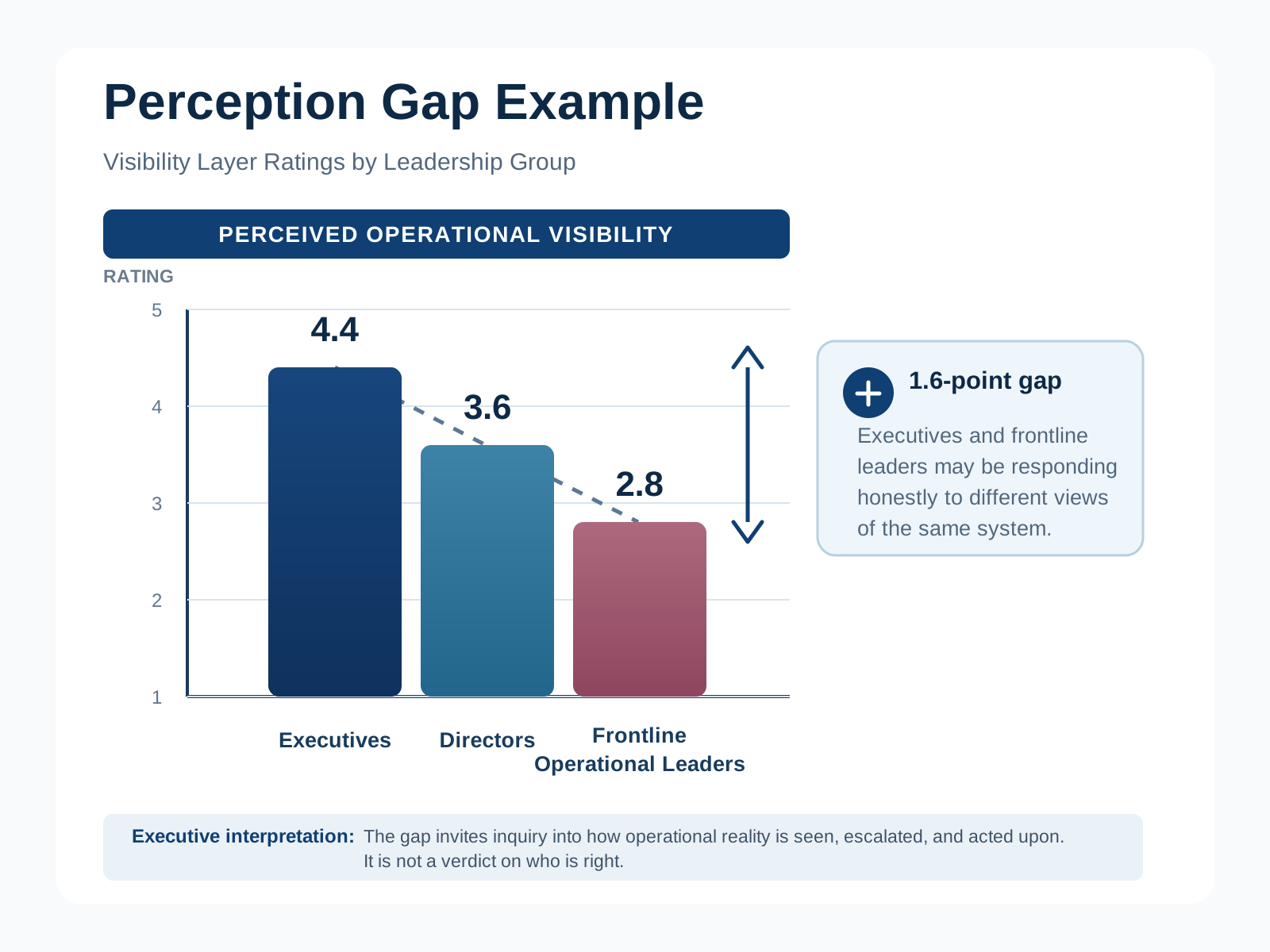
Consider a composite EHR implementation example. Executives rate operational visibility highly because the implementation dashboard is current and milestones remain on track. Directors rate it much lower because unresolved workflow exceptions are accumulating across three departments. Both groups are answering honestly. They are seeing different levels of the same system. The perception-gap chart becomes useful when it directs leaders to investigate that difference rather than defend either score.
Four patterns worth taking seriously
First, watch for the clean-upward pattern: senior leaders report confidence while the leaders responsible for delivery report low visibility or unclear ownership. This may mean bad news is being filtered as it travels upward, or that the operating forums are not designed to surface unresolved work.
Second, watch for the false-alignment pattern: leaders agree that a major issue exists but do not agree who decides, what can be standardized, or when a decision is final. Meetings can sound aligned while the work continues to wait for authority.
Third, watch for the burden-transfer pattern: a change appears manageable at the executive level because local leaders and clinicians are compensating through extra effort, side conversations, manual tracking, or repeated workarounds. The organization has not solved the problem; it has moved the cost.
Fourth, watch for the delayed-recognition pattern: the people closest to the work have already changed their behavior to protect patients or keep the day moving, while leadership is still debating whether the signal is meaningful. By the time an aggregate metric moves, the organization may already face a more difficult recovery task.
How to investigate a perception gap
Do not ask people to defend their score. Ask what conditions made the score reasonable from their point of view. Compare what information each group receives, how quickly it arrives, how it is aggregated, what gets filtered before it moves upward, and what people do when the formal path does not resolve an issue.
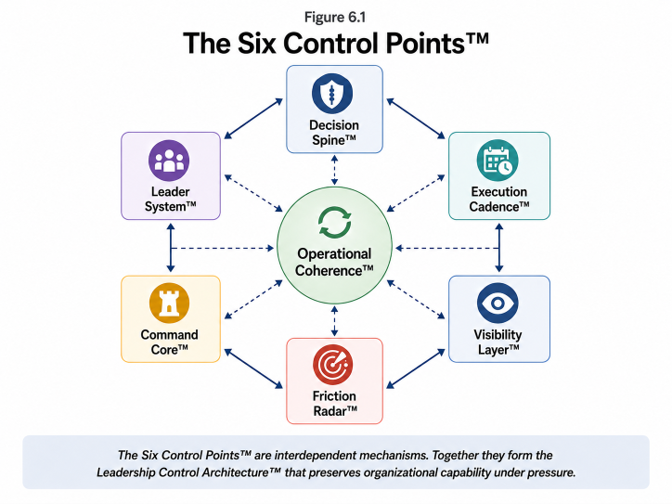
A focused review should bring the relevant leadership layers together around the same question: what operating evidence supports or challenges this gap? Compare issue age, reopened items, time to decision, huddle follow-through, workload strain, and examples of informal workarounds. Then identify the decision or escalation route through which the issue should have become visible. A control point is one of the leadership mechanisms governing decisions, visibility, escalation, and coordinated execution; the aim is to locate the mechanism under strain, not to force agreement.
AHRQ’s TeamSTEPPS guidance describes situation monitoring as active scanning that helps teams build shared situational awareness and, through communication, a shared mental model. The same guidance recognizes that different perspectives can add value when teams deliberately compare them. Research on psychological safety similarly supports the importance of conditions in which people can raise concerns and discuss uncertainty. In this article, the conclusion is an inference: a perception gap may indicate not only different information, but also a weak route for early friction to be voiced, heard, and acted upon.
How to convert the finding into action
Name the gap without judging it. For example: ‘Our executive view of visibility is stronger than the view reported by operational and frontline leaders. We need to understand whether the difference reflects timing, data access, escalation behavior, or a real breakdown in our shared operating view.’ This makes the issue discussable without assigning blame.
Then make one or two focused decisions. Name the owner, define the escalation signal, identify the review forum, and select a small measure set that will show whether the change is helping. The goal is not a larger scorecard. It is a credible path from signal to decision, action, and verification.
Close the loop with the people whose experience surfaced the gap. Explain what was learned, what will change, and what will be watched next. Be candid when evidence is incomplete or a broader decision will take time. Revisit the pattern after two to four weeks and decide whether the organization needs a different intervention, broader validation, or continued monitoring.
Sources and Related Evidence
Research grounding for the executive method.
- AHRQ’s TeamSTEPPS situation-monitoring guidance — on shared situational awareness, shared mental models, and the value of recognizing different team perspectives.
- Edmondson’s research on psychological safety and team learning — on the conditions that support interpersonal risk taking and learning behavior in work teams.
How Stability Edge Helps
See what your leadership gaps may be signaling.
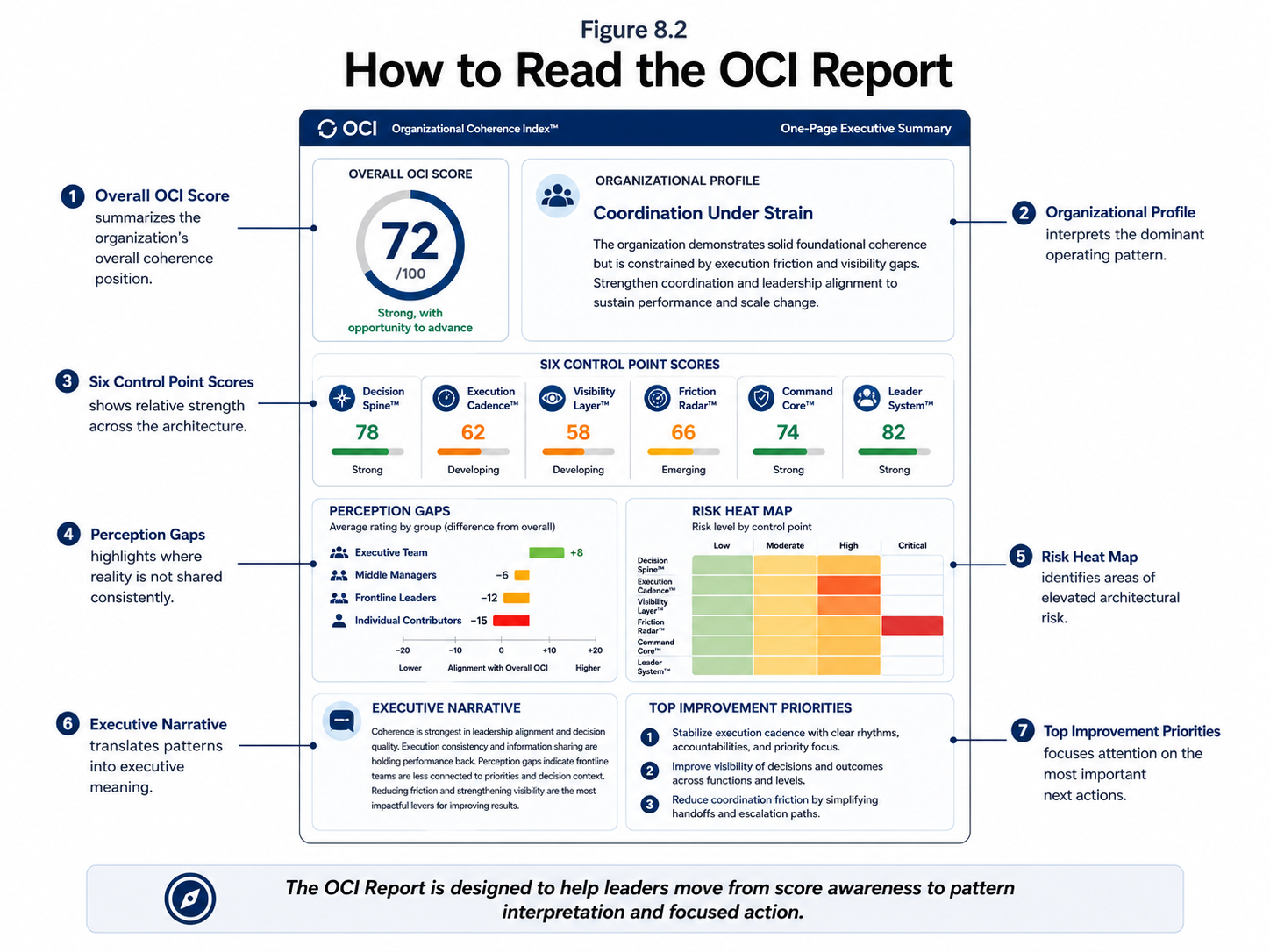
Stability Edge uses OCI perception gaps alongside local operating evidence to help executive teams identify where visibility, decision flow, escalation, or cross-functional coordination is breaking down. The result is a focused leadership response—not a debate over whose view is correct.
See How the OCI Identifies Leadership Perception GapsBook an Executive BriefingFrequently Asked Questions
Questions leaders ask about this topic
Are perception gaps always a sign of poor leadership?
No. Different roles naturally have different information and experiences. The concern is a large or persistent gap that leadership does not examine, validate, or use to improve how the organization sees, decides, escalates, and coordinates.
How can leaders validate a perception gap?
Pair the reported experience with targeted local evidence: issue-to-resolution time, repeat escalations, workload indicators, huddle follow-through, decision age, and focused listening with people close to the work.
Should executives try to eliminate every difference in perspective?
No. The aim is not identical opinions. It is enough shared understanding to make timely, coordinated decisions while preserving the perspective of people working at different levels of the organization.