Decision authority
Identify the decisions slowing the work, name who can make them, and clarify the evidence and deadline required for closure.

Clinical Operations Consulting
Stability Edge helps clinical and operational leaders make high-consequence work easier to direct when decisions, handoffs, and escalation are no longer holding together.

When Clinical Work Crosses Boundaries
Clinical operations rarely break because one team stops trying. Pressure builds when a care-delivery issue moves across roles, departments, and systems, while the people responsible do not have a shared route for deciding what matters, escalating what cannot wait, and carrying the answer back into the work.
Stability Edge works with the leaders accountable for the outcome to define the operating condition, name the decision authority, connect the evidence, and establish a review rhythm that turns attention into reliable follow-through.
Clinical workarounds keep multiplyingTeams are compensating for a handoff, decision, or exception that has not been resolved at the right level.
Escalations do not reach closureImportant issues appear in meetings and reports repeatedly because ownership, evidence, or a decision deadline is unclear.
Leaders have competing picturesClinical, operational, and technology teams can each describe part of the challenge, but no one view is strong enough to direct action.
What The Work Strengthens
The work concentrates on the leadership conditions that help clinical, operational, and technology teams respond as one system when a patient-care workflow or major change is under strain.
Identify the decisions slowing the work, name who can make them, and clarify the evidence and deadline required for closure.
Surface where ownership or information is getting lost between clinical, operational, technology, and transformation teams.
Give urgent clinical-operating risk a dependable route to the right leadership forum without turning every adjustment into an executive emergency.
Use a practical review rhythm to confirm what changed, who owns the next action, and whether the response is reducing recurring friction.
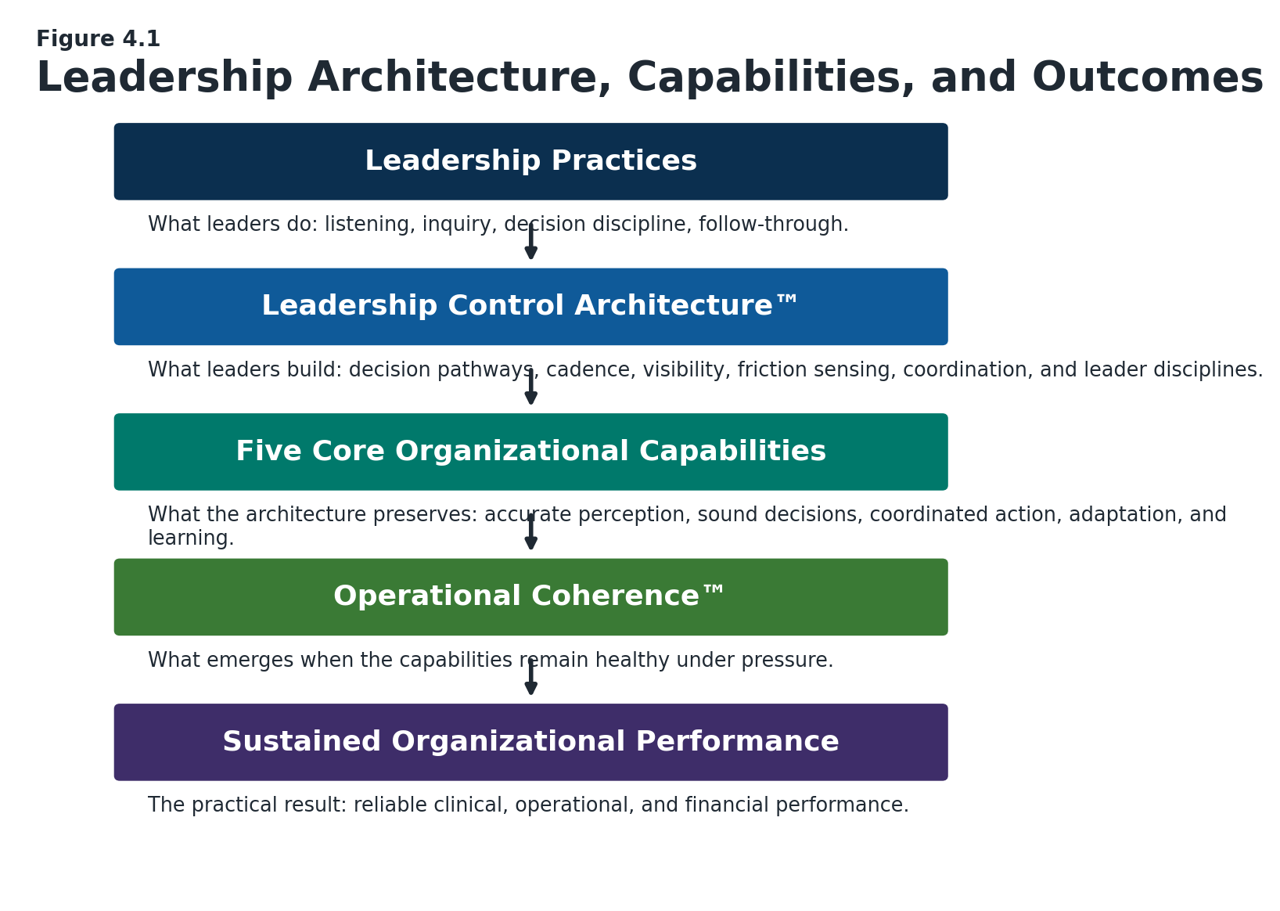
A Leadership Operating Response
Clinical redesign, informatics, implementation, quality, and local operations all matter. Yet some of the most consequential issues sit between those responsibilities. When they do, a dashboard alone cannot provide the authority, context, or follow-through required to move the work.
Stability Edge helps the leadership team build a common operating picture, decide where attention can change the outcome, and maintain a cadence that tests whether the response is actually helping the people carrying the work.
How An Engagement Begins
The engagement stays tied to one real operating question, rather than creating a separate layer of assessment or reporting.
Clarify the outcome at risk, the affected work, the teams involved, and the decisions or handoffs that need a stronger route.
Work with accountable leaders to establish authority, escalation boundaries, usable visibility, and a practical rhythm for action.
Review whether decisions are closing, recurring friction is reducing, and the people closest to the work can see a more reliable path forward.
A Focused Fit
This work is a fit when a clinical-operating challenge crosses functional boundaries, requires leadership trade-offs, or persists because the system around the work is not making decision ownership and escalation clear enough.
For a specific workflow redesign, explore Clinical Workflow Consulting. For transformation-wide operating pressure, Healthcare Operations Consulting provides a broader starting point.
Explore Clinical Workflow Consulting30-Minute Executive Briefing
Bring the clinical-operating concern, the leadership pressure, and the question that needs an answer. Leave with a clearer view of the most useful next step.
Stability Edge helps healthcare leaders strengthen the operating conditions around a consequential clinical challenge: decision authority, cross-functional workflow handoffs, escalation, shared visibility, and follow-through.
No. Stability Edge does not provide clinical staffing, clinical services, revenue-cycle outsourcing, or technical implementation. The work helps accountable leaders make the systems around clinical operations easier to direct when the pressure crosses teams.
It is most useful when a clinical-operating challenge cannot be resolved inside one department: a high-risk handoff, a new care model, EHR or AI-enabled workflow change, repeated escalation, or an operational recovery effort.
The core group usually includes the executive sponsor, clinical leaders, operational leaders, and the technology or transformation leaders who are accountable for the affected work.