Decision authority
Identify the decisions that need enterprise ownership, name who has authority to make them, and define the evidence and deadline required to reach closure.
 Talk with MarkGet a Free 30-Minute Assessment Call
Healthcare Leadership Consulting
Stability Edge helps senior healthcare leaders create the decision, escalation, and operating disciplines that keep major change coordinated when the stakes become real.

When Leadership Capacity Is Being Spent On Friction
Healthcare leaders are often asked to carry transformation through complicated conditions: an EHR transition changing daily work, an AI-enabled workflow shifting accountability, a clinical operating problem crossing departments, or a recovery effort that is losing momentum. The challenge is rarely a lack of expertise. It is that too many decisions, signals, and trade-offs are arriving without a dependable way to connect them.
Stability Edge works with the leaders responsible for the outcome to make the operating response practical. The work clarifies which decisions require enterprise authority, how unresolved friction reaches the right forum, what evidence leaders need, and how answers return to the teams doing the work, with clear expectations for ownership and follow-through.
Important decisions keep reopeningIssues receive attention but not closure because ownership, evidence, or a decision deadline is unclear.
Leadership forums are multiplyingMeetings and updates increase, yet leaders still lack one shared view of the operating risks that require action.
Teams are solving around the systemLocal workarounds are keeping work moving while leaders lose visibility into the burden and trade-offs accumulating across functions.
What This Work Strengthens
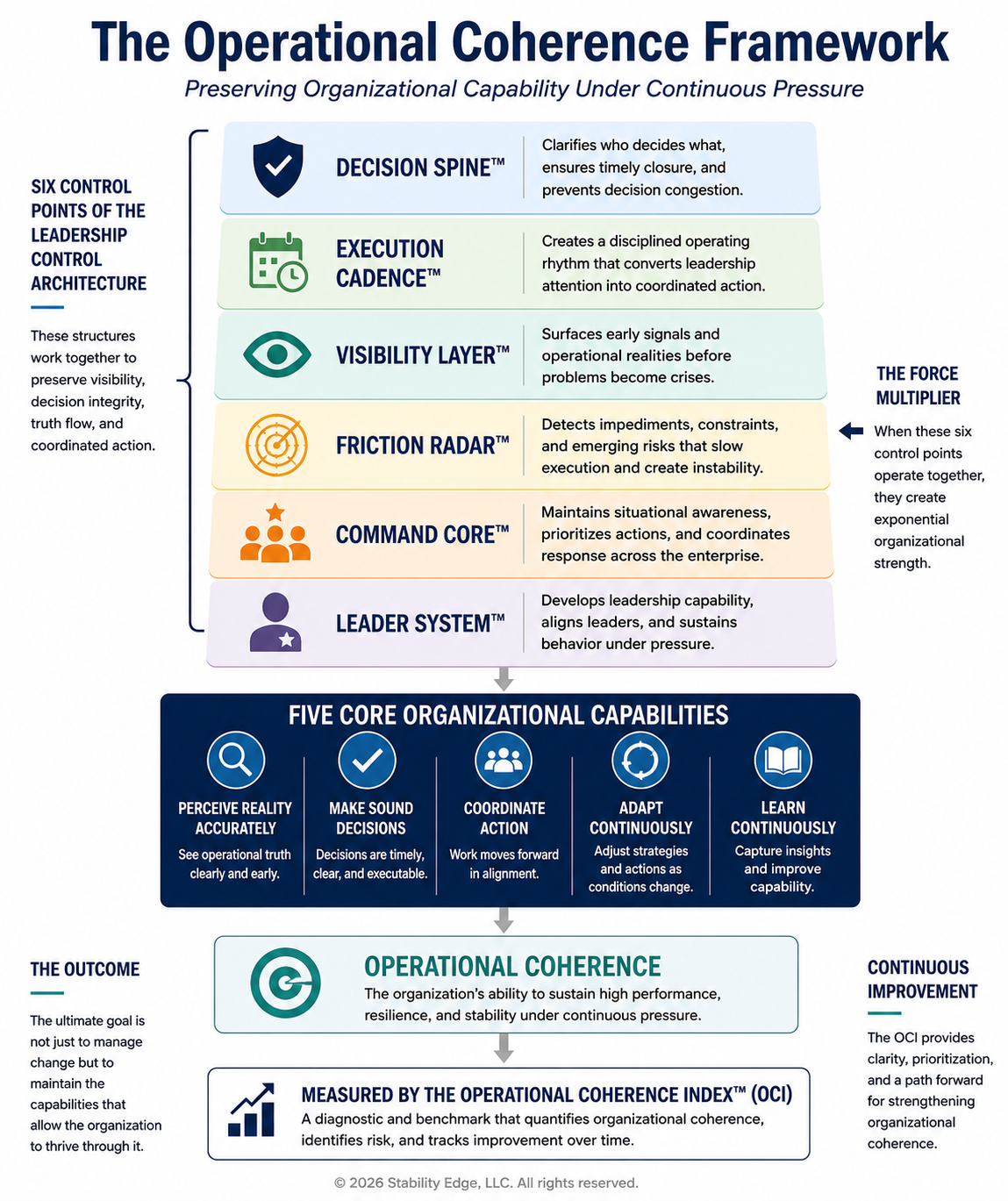
The engagement focuses on the conditions that allow accountable leaders to act as one operating system without collapsing every decision into a single committee.
Identify the decisions that need enterprise ownership, name who has authority to make them, and define the evidence and deadline required to reach closure.
Set clear thresholds for what needs rapid cross-functional attention, what can move through normal management, and how unresolved work is brought forward without creating noise.
Connect executive reporting with the signals that show whether work is becoming easier or harder to carry, including repeated exceptions, delays, workarounds, and uneven handoffs.
Establish a review rhythm that moves from signal to decision to accountable action, then checks whether the response reduced the friction it was meant to address.
Not A Generic Leadership Program
Healthcare leadership consulting is most valuable when it is tied to a real operating challenge, not separated from the work as a standalone development exercise. A strong leadership group still needs a shared way to direct decisions, surface cross-functional friction, and hold commitments together when a change affects clinical, operational, and technology teams at the same time.
Stability Edge starts with the pressure point that matters now. It might be a go-live that is approaching faster than decision clarity, an executive team struggling to see the same operating reality, or a transformation program that has more activity than coordinated follow-through. The work turns that condition into a manageable leadership response.

Founder-Led Advisory
Mark C. Medlin brings more than 35 years in transformation, organizational development, and improvement, including more than 20 years in healthcare settings. His work has included health systems, clinical improvement, enterprise technology delivery, workforce capability, and organizational change.
Since 2022, he has worked directly with more than 1,000 healthcare leaders in facilitated consulting and working sessions. Post-session evaluations consistently show 4.5 to 5.0 out of 5 for recommendation and practical application, with an average effectiveness score of 4.75 out of 5.
He developed the Operational Coherence Index™ to help leadership teams see where decision flow, visibility, escalation, coordination, and capacity are helping or hindering the work. That perspective makes the engagement useful when the problem does not belong neatly to one department or one delivery method.
Meet Mark C. MedlinHow An Engagement Begins
The engagement is shaped around the transformation, operating condition, and decisions in front of the team. It creates a practical next move, not another abstract model for leaders to carry.
Clarify the outcome at risk, the operating pressure, the leaders and teams involved, and the decisions or handoffs that are slowing the work.
Establish the authority, escalation rules, evidence requirements, and review rhythm needed to move the highest-consequence issues to a decision and accountable action.
Review whether the operating response is improving decision closure, reducing repeated friction, and giving leaders a more credible view of what still needs their attention.
What Leaders Leave With
The outputs are matched to the real challenge, but they consistently make the work of leadership easier to direct, review, and sustain.
A Focused Fit
This work is a fit for health system leaders facing a high-consequence change that cuts across clinical, operational, technology, and transformation responsibilities. It is especially useful when the organization has capable teams, clear effort, and plenty of reporting, yet important decisions are still slow, escalations are losing shape, or operating conditions are becoming difficult to see.
For a defined clinical workflow redesign, explore Clinical Workflow Consulting. For an upcoming EHR activation or active launch strain, Go-Live Readiness and EHR Go-Live Support provide more targeted starting points.
Explore Clinical Workflow Consulting30-Minute Executive Briefing
Bring the transformation, the operating concern, and the question your leadership team needs answered. Leave with a clearer view of the next useful step.
Stability Edge helps senior healthcare leaders strengthen the operating conditions that allow cross-functional work to move: clear decision authority, disciplined escalation, useful visibility, and dependable follow-through.
No. The work is anchored to a real transformation or operating challenge. It helps leaders design and use the shared decision and review disciplines that their teams need while the work is under pressure.
It is most useful before or during a significant EHR, AI-enabled workflow, clinical operations, or enterprise change when leaders are carrying more cross-functional decisions than the current operating rhythm can reliably absorb.
The right group includes the executive sponsor and the leaders accountable for the affected clinical, operational, technology, informatics, and transformation work. Participation follows the decisions the organization needs to make, not a generic leadership curriculum.
Change management supports adoption and project management organizes delivery. Stability Edge focuses on the leadership controls around that work: how leaders see emerging friction, make enterprise decisions, resolve escalation, and verify that action is holding in the work.