Priority architecture
Clarify the outcomes that need protection, the few transformation commitments that matter most, and the dependencies or tradeoffs that must be visible before separate initiatives create avoidable operational strain.
 Talk with MarkGet a Free 30-Minute Assessment Call
Healthcare Strategy Consulting
Stability Edge helps health system leaders turn a transformation strategy into clear priorities, connected decisions, and practical follow-through when the work crosses clinical, operational, and technology boundaries.

When The Strategy Is Sound But The Work Is Not Holding
Health systems carry transformation strategies through conditions that change faster than a planning cycle can capture. An EHR transition alters clinical and operational work. An AI-enabled workflow creates new questions about oversight, exceptions, and capacity. A recovery effort competes with the demands of current service delivery. Each priority can be defensible on its own, yet the combined work asks leaders to settle tradeoffs across roles, units, and time horizons.
The strain appears when strategy stays at the level of initiatives, while the organization has no dependable way to decide what takes precedence, hear where the work is breaking down, or return a clear answer to the people carrying it. Meetings multiply. Local teams make reasonable workarounds. Executive reporting can look orderly while important decisions, handoffs, and accountabilities are losing connection.
Stability Edge helps leaders turn that condition into a practical operating response. The work is centered on the leadership decisions required to protect the outcome, the evidence needed to make them, and the disciplines that keep action coordinated when the original plan meets real operating pressure.
Priorities compete without a clear tradeoffEvery initiative has a sponsor, but leaders lack a shared way to decide which risk, dependency, or decision must move first.
Strategy meetings do not settle the workImportant issues return to the same forums because authority, evidence, or a decision deadline is not clear enough to produce closure.
Execution is fragmenting across teamsClinical, operational, technology, and transformation leaders are advancing separate responses without one visible route for resolving the conflicts between them.
What This Work Strengthens
The engagement concentrates on the few controls that turn a broad transformation direction into decisions, priorities, and review routines leaders can use together.
Clarify the outcomes that need protection, the few transformation commitments that matter most, and the dependencies or tradeoffs that must be visible before separate initiatives create avoidable operational strain.
Identify the enterprise decisions leaders need to settle, name the accountable owner, define the evidence that changes the decision, and make clear how the answer reaches the teams responsible for execution.
Connect the signals that show whether strategy is holding in the work, including unresolved dependencies, recurring friction, exceptions, delayed commitments, and direct experience from affected teams.
Establish a concise executive rhythm for reviewing what changed, deciding what needs action, confirming ownership, and checking whether the response reduced pressure instead of moving it to another team.
From Strategic Intent To Operating Reality
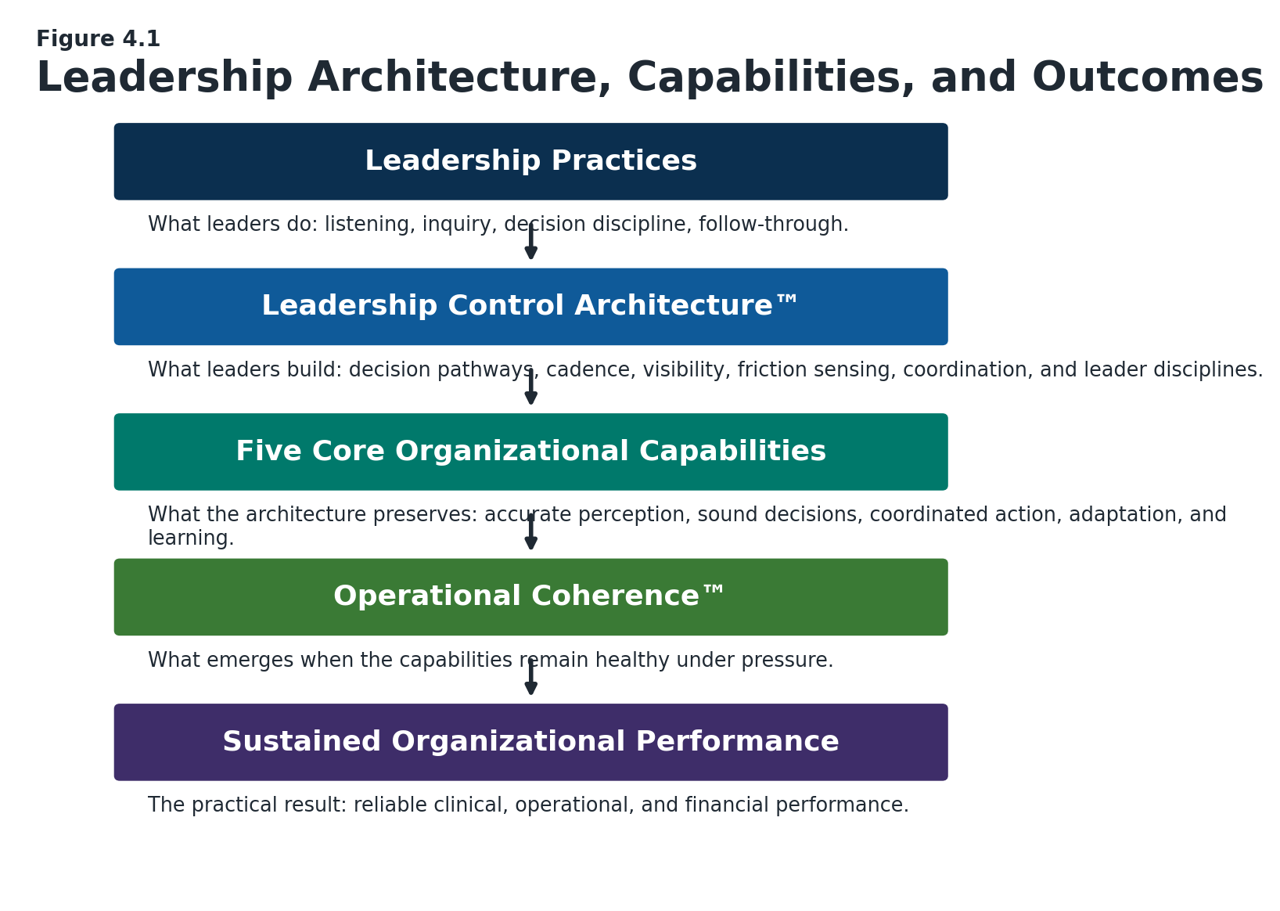
A transformation strategy needs more than a set of approved initiatives. Leaders need a practical way to recognize when an initiative is creating strain elsewhere in the system, decide whether that signal requires intervention, and make the response visible to the people who need to act on it. Otherwise, capable teams can spend months delivering against separate plans while unresolved handoffs and tradeoffs accumulate between them.
Stability Edge does not replace the teams responsible for the work. Implementation partners, program leaders, clinical and operational experts, informatics leaders, training teams, and change teams retain their essential roles. The focus is the Leadership Control Architecture™ that allows those roles to work from the same operating condition when priorities conflict or a new risk appears.
The result is a more usable leadership response. Executive sponsors can see the decisions that require their attention. Teams have a clear route for raising cross-functional issues. The organization can distinguish ordinary adjustment from the signals that threaten the outcome the strategy was meant to protect.

Founder-Led Advisory
Mark C. Medlin brings more than 35 years in transformation, organizational development, and improvement, including more than 20 years in healthcare settings. His experience spans health systems, clinical improvement, enterprise technology delivery, workforce capability, and organizational change.
Since 2022, he has worked directly with more than 1,000 healthcare leaders in facilitated consulting and working sessions. Post-session evaluations consistently show 4.5 to 5.0 out of 5 for recommendation and practical application, with an average effectiveness score of 4.75 out of 5.
He developed the Operational Coherence Index™ to help leaders see where decision flow, visibility, escalation, coordination, and capacity are helping or hindering transformation. That perspective gives executive teams a way to work on the condition underneath a stalled strategy, rather than treating every issue as an isolated delivery problem.
Meet Mark C. MedlinHow The Engagement Begins
The work begins with a live transformation condition, the outcome at stake, and the leadership question that is consuming attention or preventing a clear next move.
Clarify the transformation outcome, the affected work, the commitments under pressure, and the decisions, dependencies, or signals that need stronger executive attention.
Work with accountable leaders to define priority tradeoffs, decision authority, evidence needs, escalation boundaries, and the practical review rhythm that keeps the response connected.
Use direct leadership input and operating evidence to check whether decisions are reaching closure, risks are visible sooner, and the strategy is becoming easier to carry across the work.
What Leaders Leave With
The outputs are built around the organization’s real strategic pressure, making it easier to move from a broad direction to clear, accountable action.
A Focused Fit
This work is a fit for health system leaders carrying a material transformation with capable specialists already involved, but without a dependable way to settle cross-functional priorities and protect the work when pressure rises. It is especially useful when the strategy crosses clinical operations, technology, workforce, governance, and executive accountability.
For a specific EHR implementation, EHR Implementation Consulting offers a more targeted starting point. For an upcoming activation, Go-Live Readiness concentrates on the leadership conditions needed through launch. Healthcare AI Change Management is the better fit when the central pressure is introducing an AI-enabled workflow.
Explore Healthcare Transformation Consulting30-Minute Executive Briefing
Bring the transformation, the leadership concern, and the outcome the organization needs to protect. Leave with a practical view of the most useful next step.
Stability Edge focuses on the operating decisions that make a health system transformation strategy usable: what must be decided, who owns the tradeoffs, what leaders need to see, and how priorities stay connected to action across functions.
No. Stability Edge does not create a generic strategic plan, run a market study, or take over program management. The work helps the executive leaders accountable for a defined transformation establish the decision and follow-through structure that lets a sound strategy hold in daily operations.
The work is a fit for enterprise changes that require clinical, operational, technology, and executive leaders to make connected decisions. That can include an EHR transition, AI-enabled workflow change, operating-model redesign, recovery effort, or transformation portfolio with competing priorities.
The core group includes the executive sponsor and the leaders who own the affected clinical, operational, technology, informatics, and transformation work. The group is built around the decisions the organization must make, rather than a standing committee or generic leadership program.
Change management, implementation, training, and project teams remain essential to delivery. Stability Edge works at the leadership layer around them, strengthening decision authority, escalation, visibility, and review disciplines when the work crosses team boundaries or the original plan no longer answers the problem.