Decision closure
Identify the decisions that are slowing the work, clarify who owns them, define the evidence required, and establish how the answer gets back to the people who need to act on it.
 Talk with MarkGet a Free 30-Minute Assessment Call
Healthcare Operations Consulting
Stability Edge helps health system leaders restore clear decisions, useful operating visibility, and coordinated follow-through when transformation is putting daily operations under strain.

When Operations Cannot Absorb More Change
Most health systems do not need another abstract operating model when a major change begins to strain the work. They need a clear way to address the issue that is already consuming leadership attention: a decision that keeps returning, an escalation path that has become noisy, a workflow problem that is crossing departments, or a recovery effort that is losing momentum.
Stability Edge works with the leaders responsible for the outcome to define the next decision, the authority to make it, the evidence required, and the review rhythm that keeps action from fragmenting.
The same issue keeps circulatingLeaders are discussing an operational problem repeatedly because no one has the authority, evidence, or deadline needed to close it.
Escalations are competing for attentionEverything appears urgent, while the issues that require a cross-functional decision are hard to distinguish from normal adjustment work.
Operating reality is hard to seeExecutive reporting, command-center activity, and frontline experience are no longer giving leaders one usable picture of the condition.
What The Work Strengthens
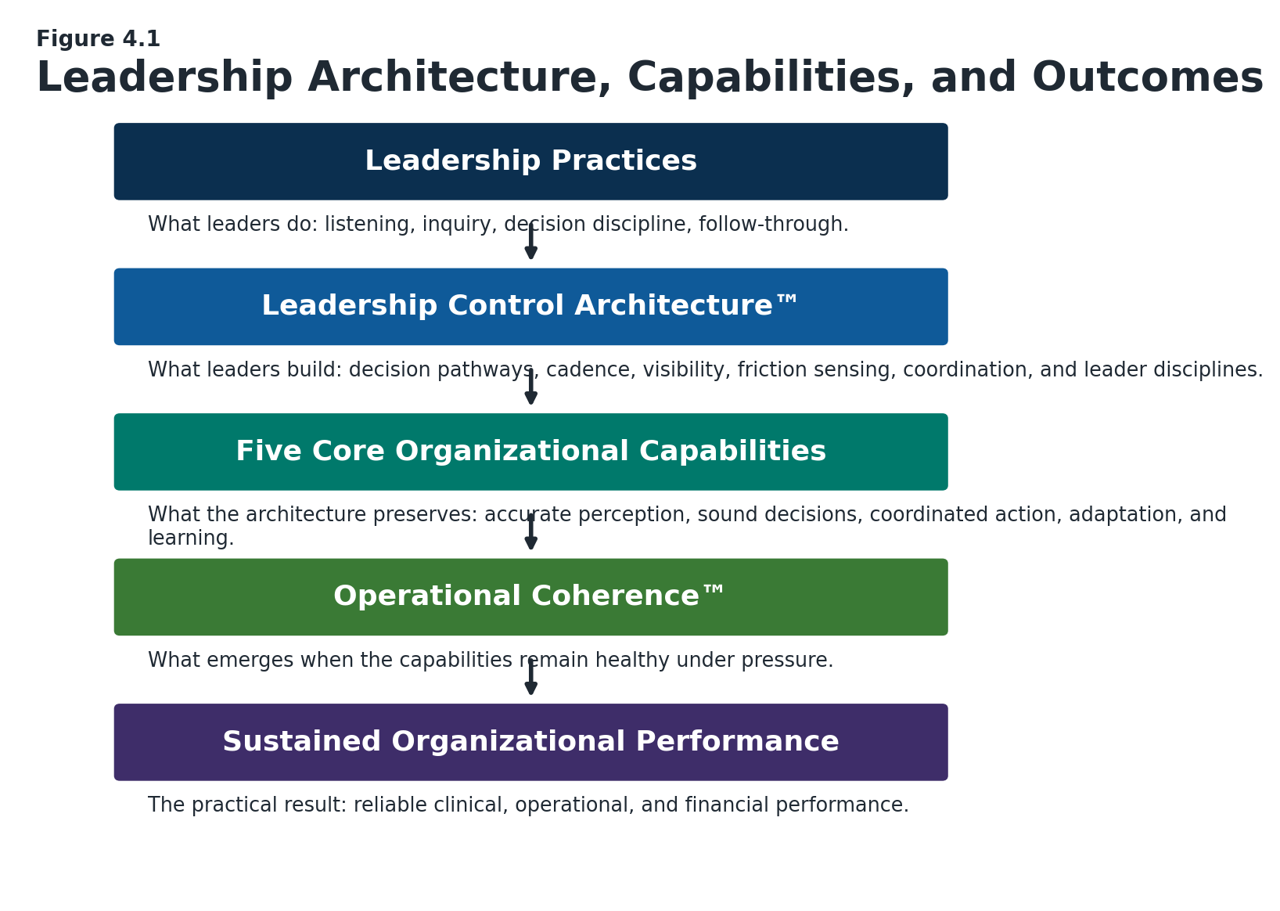
Stability Edge concentrates on the few operating conditions that determine whether clinical, operational, technology, and transformation teams can stay coordinated when the work becomes more difficult.
Identify the decisions that are slowing the work, clarify who owns them, define the evidence required, and establish how the answer gets back to the people who need to act on it.
Separate immediate risk from important work that can move through a dependable route, so leadership attention is focused where it can change the outcome.
Connect the signals that show whether friction is resolving or accumulating, including repeated exceptions, delayed handoffs, reopened decisions, and uneven burden across teams.
Establish a short, practical operating rhythm for reviewing what changed, naming the next action, confirming accountability, and checking whether the response helped.
A Different Kind Of Operations Work
Implementation, informatics, project delivery, training, and change teams each have essential responsibilities. They cannot solve every cross-functional operating problem alone. When authority is unclear, visibility is incomplete, or an issue crosses the boundaries of those teams, the leadership architecture needs to carry the response.
Stability Edge helps executive sponsors and accountable leaders define that response. The work creates a shared view of the operational pressure, the decision path needed to address it, and the cadence required to sustain follow-through after the first intervention.

Who Does This Work
Mark C. Medlin brings more than 35 years in transformation, organizational development, and improvement, including more than 20 years in healthcare settings. His experience spans health systems, clinical improvement, enterprise technology delivery, workforce capability, and organizational change.
Since 2022, he has worked directly with more than 1,000 healthcare leaders in facilitated consulting and working sessions. Post-session evaluations consistently show 4.5 to 5.0 out of 5 for recommendation and practical application, with an average effectiveness score of 4.75 out of 5.
He developed the Operational Coherence Index™ and is the author of The Stability Architect, forthcoming in 2026. The work is designed for the problems that sit between familiar disciplines, where clinical operations, technology, governance, leadership, and transformation must work as one system.
Meet Mark C. MedlinHow An Engagement Begins
The engagement stays anchored to a real leadership question, rather than a generic assessment. It can begin before a major change, during a difficult launch, or after a transition when the organization needs to stabilize the work and protect recovery.
Clarify the outcome that needs protection, the teams involved, the current pressure point, and the decisions or handoffs most exposed to delay and confusion.
Work with accountable leaders to establish authority, escalation boundaries, usable visibility, and a practical rhythm for moving the most important issues to closure.
Review whether the operating response is reducing repeated friction, improving decision closure, and giving leadership a clearer view of what still requires action.
What Leaders Leave With
The work is tailored to the operating question at hand. Typical outputs make ownership, escalation, and executive visibility easier to act on.
A Focused Fit
This work is a fit when healthcare leaders need to steady a high-consequence operational change without losing the specialized expertise already in place. It is especially useful when the pressure spans clinical and non-clinical teams, requires executive decisions, or is exposing a gap between the intended plan and the work people are actually carrying.
For a specific workflow redesign, explore Clinical Workflow Consulting. For EHR launch preparation or active launch support, Go-Live Readiness and EHR Go-Live Support provide more targeted starting points.
Explore Clinical Workflow Consulting30-Minute Executive Briefing
Bring the change, the operating concern, and the question your leadership team needs answered. Leave with a clearer view of the most useful next step.
Stability Edge focuses on the leadership operating system around a high-pressure operational challenge: how decisions reach closure, how escalation is handled, what leaders can see, and how cross-functional follow-through holds together.
No. Stability Edge does not provide staffing, revenue-cycle outsourcing, or technical implementation. The work helps accountable health system leaders strengthen the decision and operating structures their clinical, operational, technology, and transformation teams depend on.
It is most useful when a major change is creating operational drag: an EHR transition, workflow redesign, AI-enabled change, post-launch recovery, or a recurring cross-functional issue that no single department can resolve alone.
The right group usually includes the executive sponsor and the leaders accountable for the affected clinical, operational, technology, and transformation work. The engagement is designed to make their shared operating response clearer, not add another reporting layer.
Those disciplines improve workflows, adoption, or project execution. Stability Edge focuses on the leadership operating structure around that work: the decisions, escalation, visibility, and cross-functional follow-through that must hold together when pressure and tradeoffs intersect.