Performance pressure diagnosis
Clarify the operating condition behind the visible problem, including the affected work, the commitments at risk, the cross-functional handoffs, and the recurring friction leaders need to address first.
 Talk with MarkGet a Free 30-Minute Assessment Call
Healthcare Performance Improvement Consulting
Stability Edge helps healthcare leaders improve operating performance by making the decision, visibility, escalation, and follow-through conditions around a high-pressure change clear enough to hold in practice.

When Performance Is Not Moving
A health system can see missed commitments, delayed decisions, recurring workarounds, uneven adoption, or rising operational strain without having a shared view of what is producing the pattern. Teams may be working hard. Leaders may have reports, initiatives, and meetings. Yet the work does not improve because the issue moves across clinical, operational, technology, and leadership boundaries faster than the organization can respond.
That is not solved by a generic improvement program. The useful question is what the operating system is asking people to carry. Who has the authority to resolve the decision? What evidence should change the priority? How does a concern move from the work to the right people? How does the answer return, and how do leaders know whether it reduced the burden rather than moving it somewhere else?
Stability Edge helps accountable leaders make that response visible and usable. The work is built around a real performance pressure, not an abstract maturity model. It gives leaders a way to see the condition, direct the next decision, and establish the disciplines that make improvement more dependable across the people doing the work.
Improvement work keeps restartingTeams identify the same issue in different forums because decisions, ownership, or follow-through are not carrying from one review to the next.
Reporting is increasing without clarityLeaders receive more updates and more measures, but cannot see which signal requires action, which team owns the response, or whether the work is improving.
Local fixes are doing the heavy liftingCapable managers and frontline teams keep services moving through workarounds that reduce short-term friction while hiding the cross-functional problem that needs an enterprise response.
What This Work Strengthens
The engagement focuses on the practical controls that help leaders act on the right signal, settle the decisions that are holding the work back, and verify that the response improves conditions where care and operations happen.
Clarify the operating condition behind the visible problem, including the affected work, the commitments at risk, the cross-functional handoffs, and the recurring friction leaders need to address first.
Name the decisions that need a clear owner, the evidence required to make them, the authority to settle tradeoffs, and the response window that keeps the work moving.
Bring together the few signals that show whether the condition is changing, including unresolved work, emerging friction, leadership commitments, and direct experience from the teams carrying the change.
Establish a concise review rhythm that connects decisions to actions, accountable owners, return communication, and a check that the response made the work safer, clearer, or easier to carry.
From Performance Activity To Performance Conditions
Performance improvement can lose force when every problem is treated as an isolated project. One team adjusts a workflow, another adds a report, another escalates the consequence, and leaders are left to infer whether the combined effort is changing the condition. The organization can become busier while the underlying decision delay, unclear handoff, or weak follow-through remains intact.
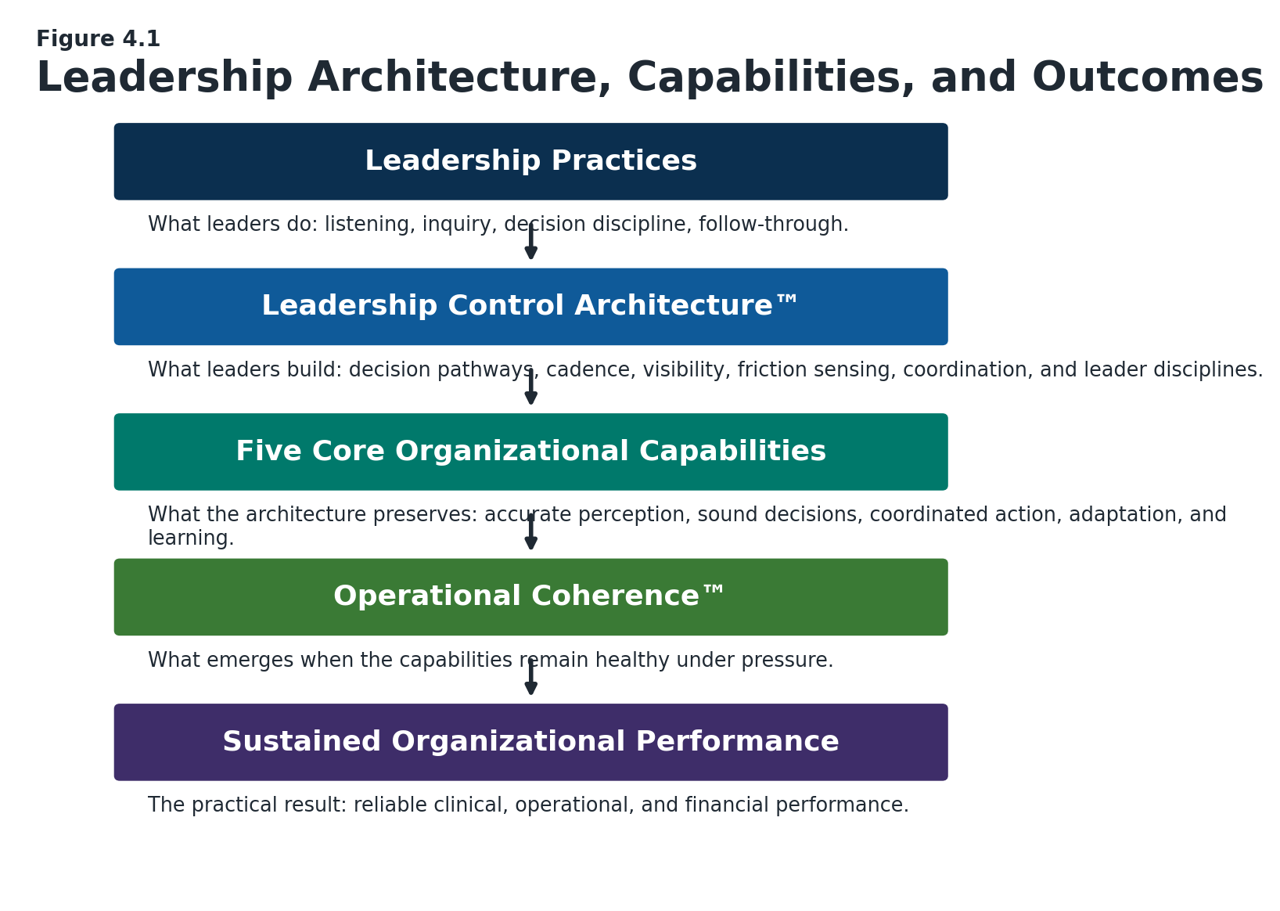
Stability Edge helps leaders work across that pattern without taking over the functions already responsible for delivery. Clinical improvement, operations, technology, implementation, and change teams retain their essential roles. The focus is the leadership architecture that lets those roles recognize the same pressure, resolve the right tradeoffs, and keep their actions connected.
This is particularly useful when the performance concern sits inside a major transition, such as an EHR implementation, an AI-enabled workflow change, a clinical operating redesign, or an active recovery period. In those moments, a stronger operating response can prevent ordinary friction from becoming the normal way people experience the work.

Founder-Led Advisory
Mark C. Medlin brings more than 35 years in transformation, organizational development, and improvement, including more than 20 years in healthcare settings. His work spans health systems, clinical improvement, enterprise technology delivery, workforce capability, and organizational change.
Since 2022, he has worked directly with more than 1,000 healthcare leaders in facilitated consulting and working sessions. Post-session evaluations consistently show 4.5 to 5.0 out of 5 for recommendation and practical application, with an average effectiveness score of 4.75 out of 5.
He developed the Operational Coherence Index™ to help leaders see whether decision flow, visibility, escalation, coordination, and capacity are helping or hindering the work. That perspective is valuable when a performance concern cannot be improved inside one department because the operating conditions cross the system.
Meet Mark C. MedlinHow The Engagement Begins
The work stays grounded in one real condition leaders need to improve, the outcome they must protect, and the places where decision flow, visibility, or follow-through are making progress harder than it needs to be.
Clarify the performance concern, affected work, leadership stakes, and the decisions or handoffs most likely to be sustaining the pressure.
Define the decision authority, evidence needs, escalation boundaries, operating signals, and review rhythm that help accountable leaders respond across functions.
Use direct leadership input and operating evidence to check whether the response is reducing repeated friction, strengthening ownership, and making the work more reliable in practice.
What Leaders Leave With
The outputs fit the condition in front of the organization, while giving leaders a clear route from a signal in the work to an accountable decision, coordinated action, and visible verification.
A Focused Fit
This work is a fit for health system leaders facing a high-consequence performance concern that crosses clinical, operational, technology, or transformation boundaries. It is especially useful when there is no shortage of effort, but decisions are slow, reports are not producing a shared view, or local workarounds are carrying problems that require a broader response.
For a defined EHR implementation, EHR Implementation Consulting provides a more specific starting point. For an upcoming activation, Go-Live Readiness focuses on the leadership conditions that must hold through launch. Healthcare Change Management Consulting is the better fit when the central concern is adoption across a broader organizational change.
Explore Healthcare Operations Consulting30-Minute Executive Briefing
Bring the performance pressure, the affected work, and the outcome the organization needs to protect. Leave with a practical view of the next useful step.
Stability Edge focuses on the leadership conditions around an operational performance problem: how decisions move, what leaders can see, how cross-functional friction reaches action, and how follow-through is verified in the work.
No. Those can be important priorities, but Stability Edge does not provide staffing, revenue-cycle outsourcing, clinical quality certification, or a generic cost-reduction program. The work helps accountable leaders strengthen the operating response around a defined performance pressure.
It is most useful when a health system has a performance concern that crosses functions and is not moving through the usual management routines: a strained implementation, recurring operational friction, uneven adoption, an overloaded escalation system, or a recovery effort that is losing traction.
The work is designed for an executive sponsor and the leaders accountable for the affected clinical, operational, technology, and transformation work. The right group is small enough to make decisions and broad enough to address the real cross-functional condition.
Stability Edge does not begin by adding more reporting or asking teams to work harder around an unclear system. The work uses Leadership Control Architecture to connect decision authority, visibility, escalation, coordination, and follow-through around the pressure leaders need to improve.