Decision authority
Identify the decision that is blocking progress, the leader who can make it, the information required, and the date by which the answer must reach the people affected.
 Talk with MarkGet a Free 30-Minute Assessment Call
Hospital Operations Consulting
Stability Edge helps hospital leaders bring clear authority, disciplined escalation, and coordinated follow-through to the operational problems that no department can resolve alone.

When The Problem Is Bigger Than One Department
A hospital can have capable leaders, a committed improvement team, and a full calendar of operating meetings, yet still be unable to close the problem that keeps returning. A delayed discharge decision, a handoff that breaks between departments, a launch issue that becomes a recurring workaround, or an escalation that keeps moving upward without resolution can pull attention away from patient care and exhaust the people carrying the work.
These conditions rarely improve because another status report is added. They improve when the leaders responsible for the outcome have a shared view of the condition, a decision path with real authority, and a disciplined way to verify that the response is working in practice.
Issues return without closureThe same concern appears in different meetings because the decision, owner, or evidence needed to resolve it is still unclear.
Urgency is drowning out priorityLeaders see a growing issue list but lack a dependable way to distinguish active operational risk from normal adjustment work.
The operating picture is fragmentedFrontline experience, unit-level reports, command-center activity, and executive updates do not yet form one useful view of what needs action.
What The Work Strengthens
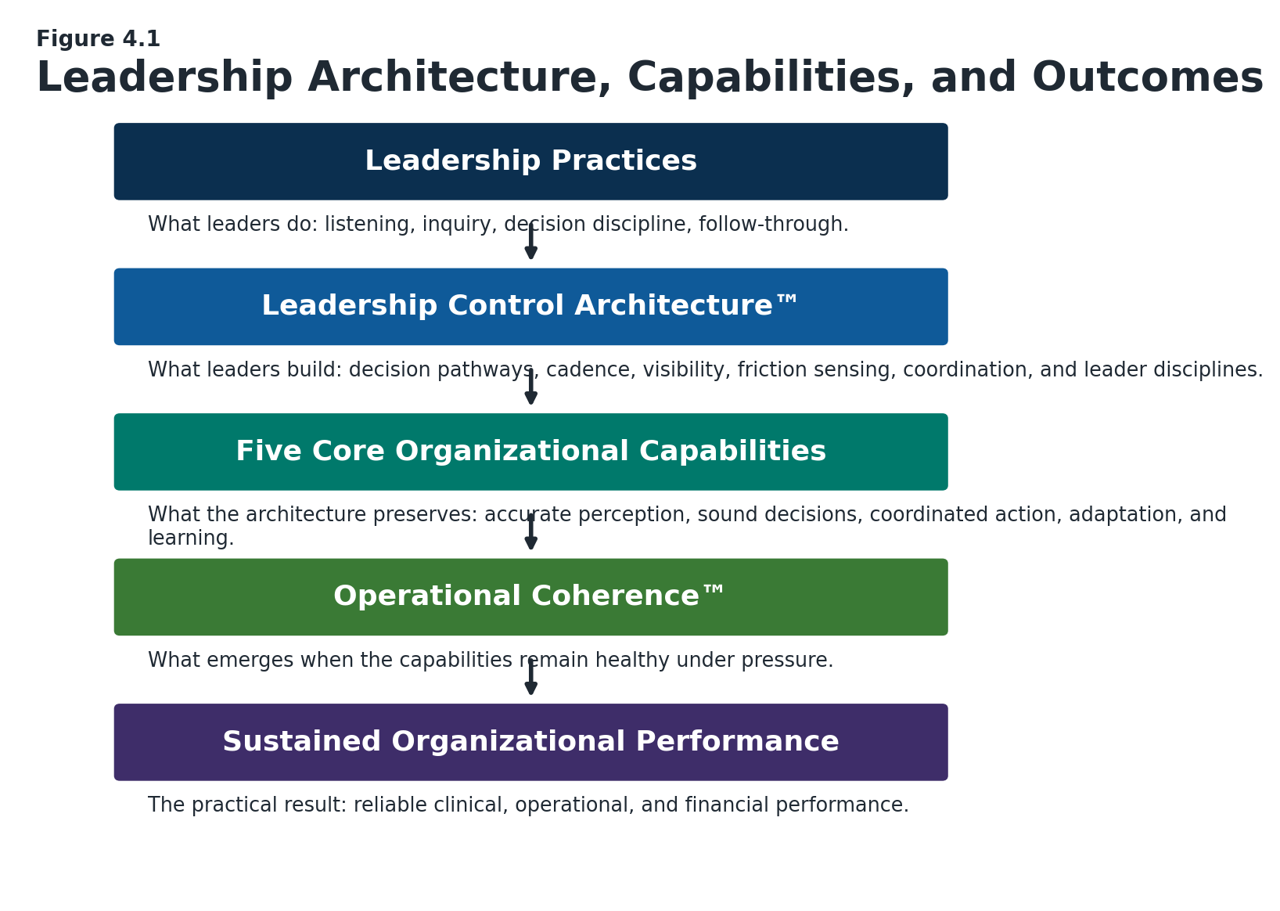
Stability Edge works with accountable hospital leaders on the leadership conditions that allow a cross-functional response to move. The focus is not a generic operating-model redesign. It is the specific decision, escalation route, evidence, and review rhythm needed for the pressure at hand.
Identify the decision that is blocking progress, the leader who can make it, the information required, and the date by which the answer must reach the people affected.
Define what should remain in the normal operating path and what requires cross-functional or executive action, so every issue does not compete for the same attention.
Bring together the few signals that show whether the condition is resolving: repeated exceptions, delayed handoffs, reopened decisions, uneven workload, and frontline friction.
Establish a short review rhythm that names the next action, confirms ownership, communicates the decision, and checks whether the change held in the work.
A Practical Starting Point
Hospital operations work can span patient flow, capacity, staffing, clinical quality, technology, finance, and local unit performance. Stability Edge does not claim to replace the specialists accountable for those domains. It works at the point where a problem is crossing their boundaries and the leadership system needs to create a coherent response.
That can mean clarifying the decision rights around an inpatient-flow constraint, creating a credible escalation route during a difficult EHR transition, or helping senior leaders distinguish a local workaround from an enterprise risk. The engagement stays attached to the real work, with enough structure to convert repeated discussion into coordinated action.
How An Engagement Begins
The work begins with an executive conversation about the operating condition, the outcome at risk, and the leaders who need to act together. It is designed to create movement in the current condition, while leaving behind disciplines the organization can continue to use.
Clarify the outcome that needs protection, the work under strain, the recurring friction, the people affected, and the decisions that cannot remain unresolved.
Define authority, escalation boundaries, evidence, and the operating forum needed to move the issue to a decision without adding a parallel bureaucracy.
Review what changed, confirm accountability and communication, and test whether the response is reducing repeated friction for the teams doing the work.
What Leaders Leave With
The exact outputs follow the condition being addressed. They are designed to make the next decision, the people accountable, and the evidence of progress clear enough to use immediately.
A Focused Fit
This work is well suited to hospital leaders facing a high-consequence issue that requires more than a department-level fix: a strained launch, a recurring flow or handoff problem, competing executive priorities, or a recovery effort that has lost its shared operating picture.
For a specific care-process redesign, Clinical Workflow Consulting is the more targeted starting point. For pre-launch or active EHR pressure, Go-Live Readiness and EHR Go-Live Support provide dedicated paths. Healthcare Operations Consulting serves broader health-system transformation conditions.
Explore Healthcare Operations ConsultingEvidence From The Leaders In The Room
Since 2022, Mark C. Medlin has worked directly with more than 1,000 healthcare leaders in facilitated consulting and working sessions. Their post-session evaluations provide direct evidence of whether the work is clear, relevant, and practical enough to use in the job.
healthcare leaders worked with directly since 2022.
consistent recommendation scores from healthcare leaders.
confidence that the tools and approaches can be applied in their work.
average effectiveness score across consulting-session evaluations.
Based on post-session evaluations from facilitated consulting and working sessions involving more than 1,000 healthcare leaders since 2022. Scores use a five-point scale and reflect recommendation, practical application, and overall effectiveness.
30-Minute Executive Briefing
Bring the issue, the teams involved, and the decision your hospital needs to make. Leave with a clearer view of the most useful next step.
Stability Edge helps hospital leaders strengthen the shared operating response around a consequential problem. The work focuses on decision authority, escalation, visibility, and follow-through when a challenge crosses clinical, operational, technology, and executive boundaries.
No. Those teams remain essential. Stability Edge works on the leadership controls around their work when the problem requires enterprise decisions, cross-functional alignment, or an operating rhythm that the existing teams cannot create alone.
No. Stability Edge does not provide staffing, revenue-cycle outsourcing, or a generic efficiency program. The work gives accountable leaders a clearer way to make and carry decisions through the operational issue they need to address.
The work is most useful when a recurring operational issue is consuming leadership attention, an EHR or workflow change is adding strain, or teams are working hard but lack a shared route to close the decisions that matter.
The core group includes the executive sponsor and leaders accountable for the affected work. Depending on the condition, that can include clinical, nursing, operations, informatics, technology, finance, transformation, and local department leaders.