The Command Center Reveals the Break
Thirty-five years inside healthcare systems, and the same sequence keeps showing up. Go-live day takes the blame for failures that were already locked in two months before the first user logged on.
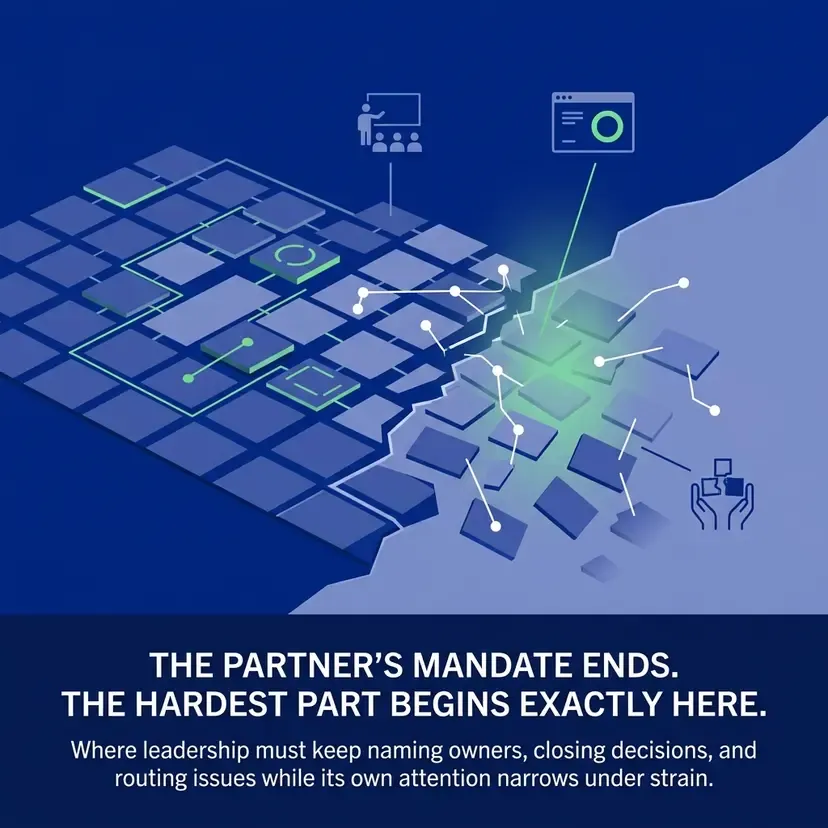
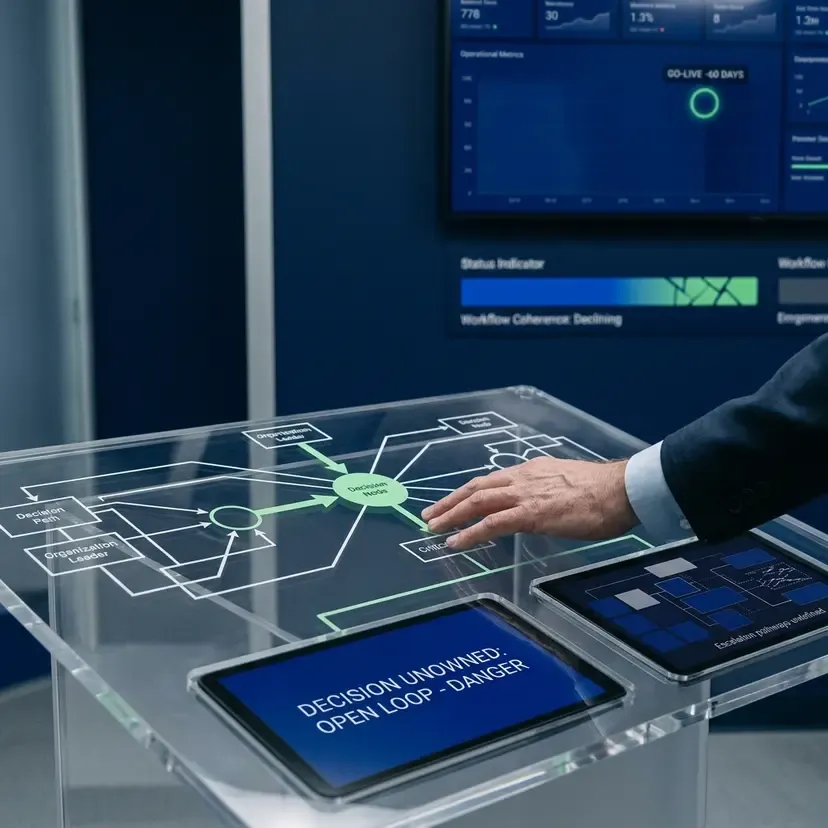
The command center gets positioned as the safety net. What it actually does is expose the decision structure the organization either built, or quietly skipped. Escalation pathways that were undefined in the 60 days before launch stay undefined at 2 a.m. on day one. Decisions stall. Teams build workarounds. The dashboard turns green while the floor turns red.
That gap between dashboard green and floor red is the diagnostic. The command center did not create it. It just made it impossible to ignore.
What Actually Breaks
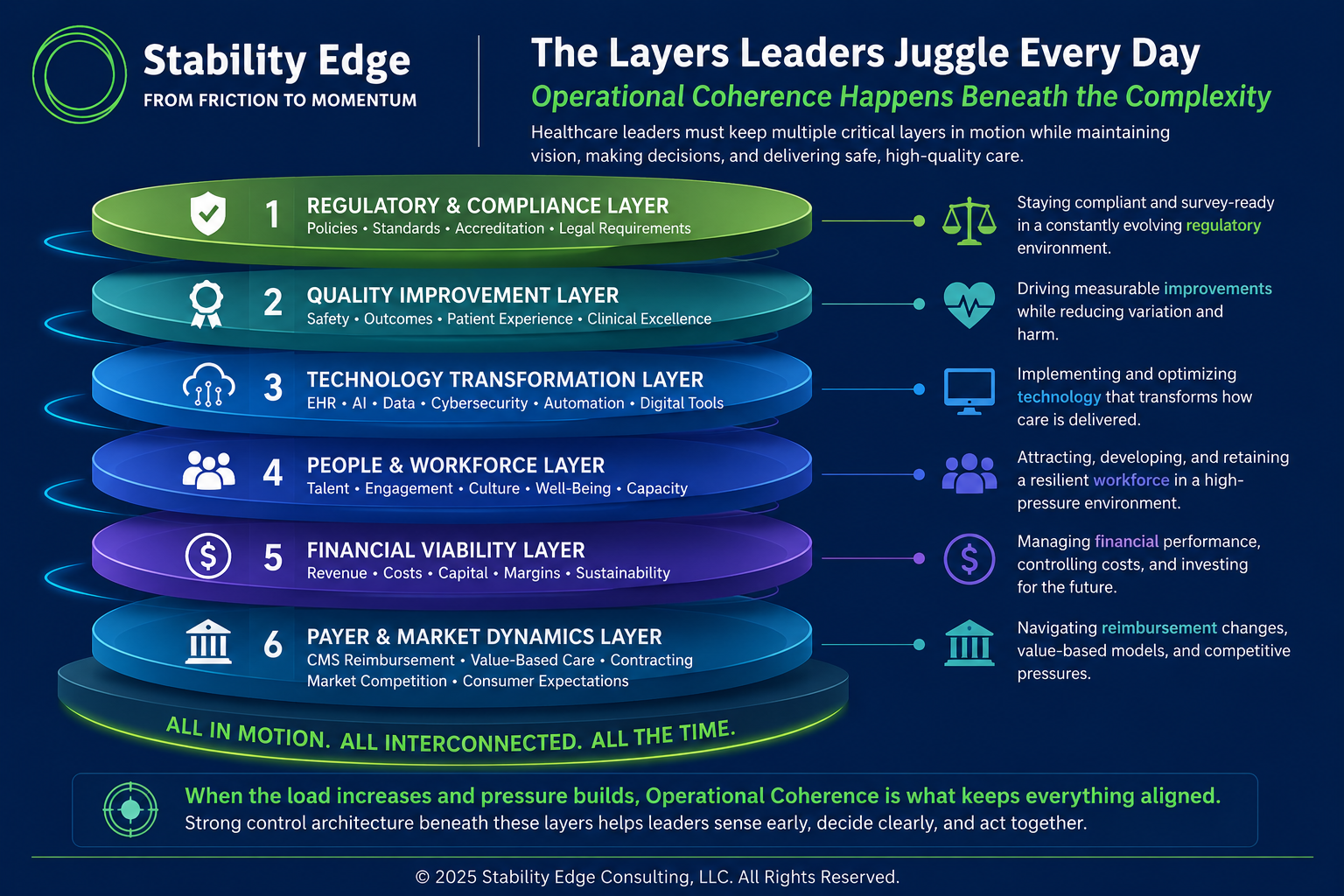
Three structural elements determine whether a go-live holds under real operational pressure. They do not get equal attention because they do not carry equal weight.
How decisions close: Unowned decisions accumulate as open loops under pressure. One stalled decision at go-live is a nuisance. Twenty stalled decisions, all waiting for an owner who was never assigned, is a systems failure. This one matters the most, and it gets the least pre-launch attention.
How truth flows: Operational reality reaches the clinical floor before it reaches executive reporting. The delay is structural. Status filtered through five layers arrives polished, condensed, and late. Leadership makes decisions on a version of reality the floor stopped living in hours ago.
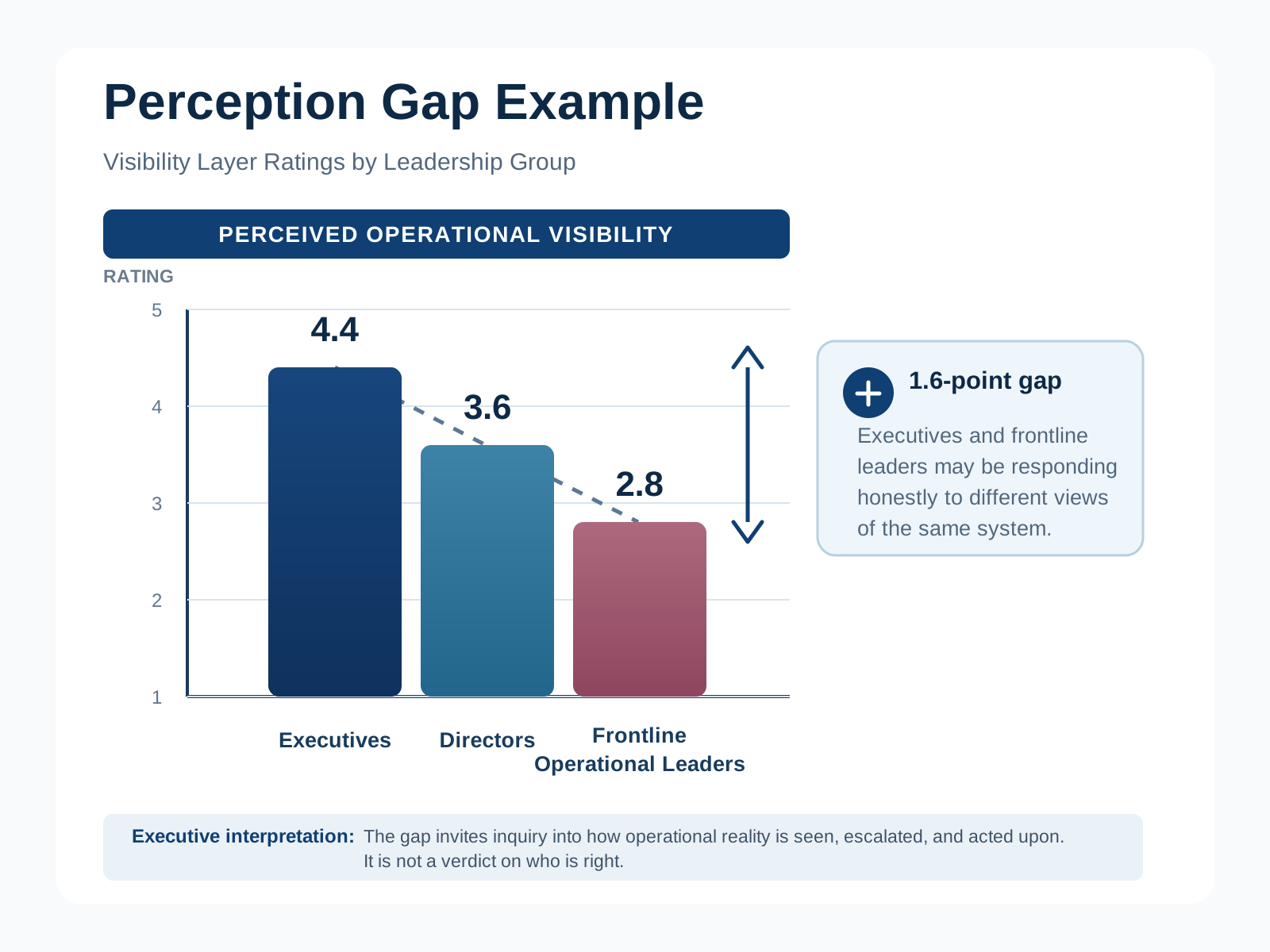
How visibility works: Related to truth flow, but distinct. Visibility is about whether the right people can see the right signals in time to act. When that architecture is not designed, workarounds become the visibility system. Workarounds were never designed for that job.
Organizations pour real resources into technical readiness. The leadership architecture that has to carry the load during go-live gets far less attention, and it carries strain poorly when it was never designed to carry it at all.
Diagnose It Before Launch Exposes It
Coherence loss shows up early. Workarounds accumulating, silence in escalation channels, and decision bottlenecks that everybody knows about and nobody owns are data. They arrive before the metrics decline, if the team knows how to read them.
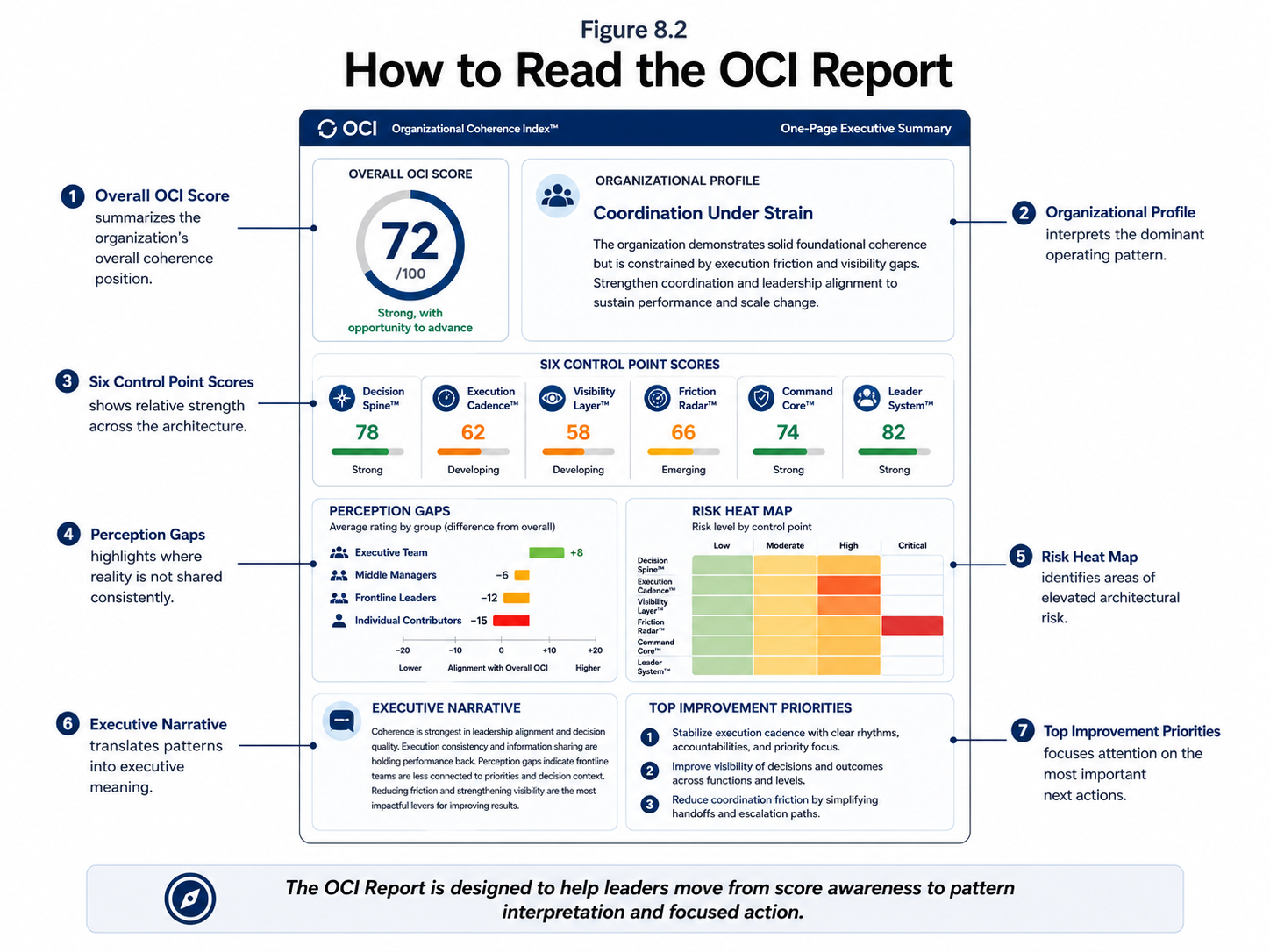
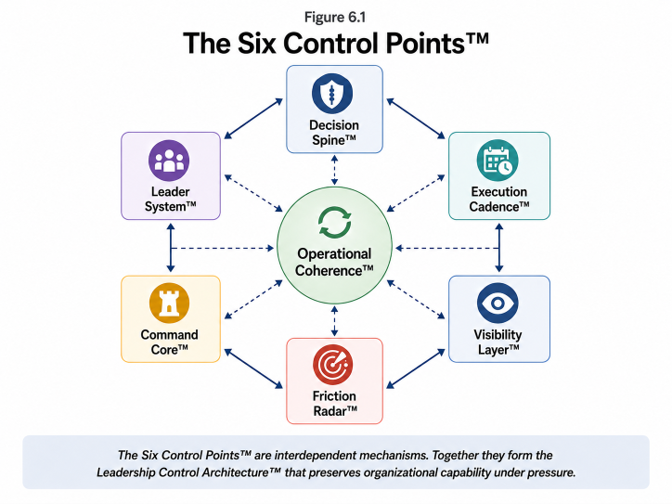
The Operational Coherence Index™ (OCI) Assessment gives leadership teams a deeper reading of what is breaking in the Leadership Control Architecture™ before day one forces the answer.
Key Takeaways
What to watch before launch
- Go-live failures are structural, not execution failures. The break happens in the 60 days before launch.
- The command center exposes pre-existing architecture. It does not create the problem.
- Decision closure is the highest-leverage structural element. Unowned decisions under pressure become systems failures fast.
- Truth flow and visibility are distinct problems that require distinct structural solutions.
- Technical readiness and leadership architecture are separate investments. Treating them as one is where the risk lives.
- Coherence loss is detectable before launch through workarounds, silence, and decision bottlenecks.
- The OCI Assessment gives leadership teams a deep structural diagnostic while there is still time to strengthen the architecture.
How Stability Edge Helps
See what pressure is doing before day one.
The free Healthcare Leadership Stress Test gives leaders a private starting point for recognizing pressure before the organization needs a deeper coordination assessment.
Take the Free 5-Minute Stress TestTalk with MarkGet a Free 30-Minute Assessment CallFrequently Asked Questions
Questions leaders ask about this topic
Why do EHR go-lives fail if teams prepare for months?
Preparation tends to concentrate on technical readiness: software configuration, training, and testing. The leadership architecture, including decision ownership, escalation pathways, and truth flow, rarely receives the same structured attention. When pressure hits on day one, the technical layer may hold while the coordination layer breaks.
What is the command center's actual role during a go-live?
The command center surfaces whatever decision structure already exists. Organizations that built clear escalation pathways and decision ownership before launch find the command center works as intended. Organizations that skipped that work find the command center overwhelmed with decisions it was never designed to handle.
What does decision closure mean in an EHR go-live context?
Decision closure means every decision that needs to be made has a named owner, a clear process, and a defined timeframe. During go-live, unowned decisions accumulate fast. Without pre-built closure mechanisms, they become bottlenecks that stall the entire operation.
How does truth flow break down during implementation?
Status updates move through reporting layers before reaching executives. Each layer tends to filter, smooth, and summarize. By the time the information arrives at the decision-making level, it can reflect a reality the clinical floor moved past hours earlier. Decisions made on that delay carry real risk.
What is the Operational Coherence Index™ (OCI) Assessment?
The Operational Coherence Index™ (OCI) Assessment is a paid deep diagnostic that examines the Six Control Points of the Leadership Control Architecture™. It gives leadership teams a structural reading of where Operational Coherence™ is at risk before go-live forces the answer.
When should a leadership team use the OCI Assessment?
The assessment is most useful in the 60-day window before go-live, when structural corrections are still possible. Running it after launch surfaces the same data, but the window for low-cost correction has already closed.
Is this relevant outside EHR go-lives?
Yes. The structural dynamics of decision ownership, truth flow, and visibility architecture apply across major organizational transformations, including merger consolidations, AI integration deployments, and significant workforce restructuring. EHR go-lives are a particularly high-pressure test case because the timeline is compressed and the operational stakes are immediate.