TL;DR at a glance
The operating risk in five points
- Healthcare IT programs frequently miss their original objectives, timelines, or budgets for organizational reasons, not simply technical ones.
- Implementation partners are contracted to make the technology work, not to hold the leadership team together when pressure peaks.
- Coordinated decision-making is often the first structural element to thin when post-launch load climbs.
- Post-go-live productivity pressure exposes whatever leadership architecture was already thin.
- Organizations can close the gap by naming decision owners and defining escalation paths before go-live, not during it.
The Setup Everyone Recognizes
A healthcare system spends eighteen months preparing for a major go-live. The implementation partner configures the platform. The internal team drives adoption. Training rooms fill. Dashboards turn green on launch day. Everyone exhales.
Then, three weeks later, the floor quietly starts to fracture, and no one can name why.
Thirty-five years of working inside complex healthcare organizations reveals that this sequence holds across Epic deployments, Oracle rollouts, and major system changes of every kind. The technology works. The people worked hard. The launch still loses ground.
That contradiction points to something most planning never accounts for.
Where the Implementation Partner's Mandate Ends
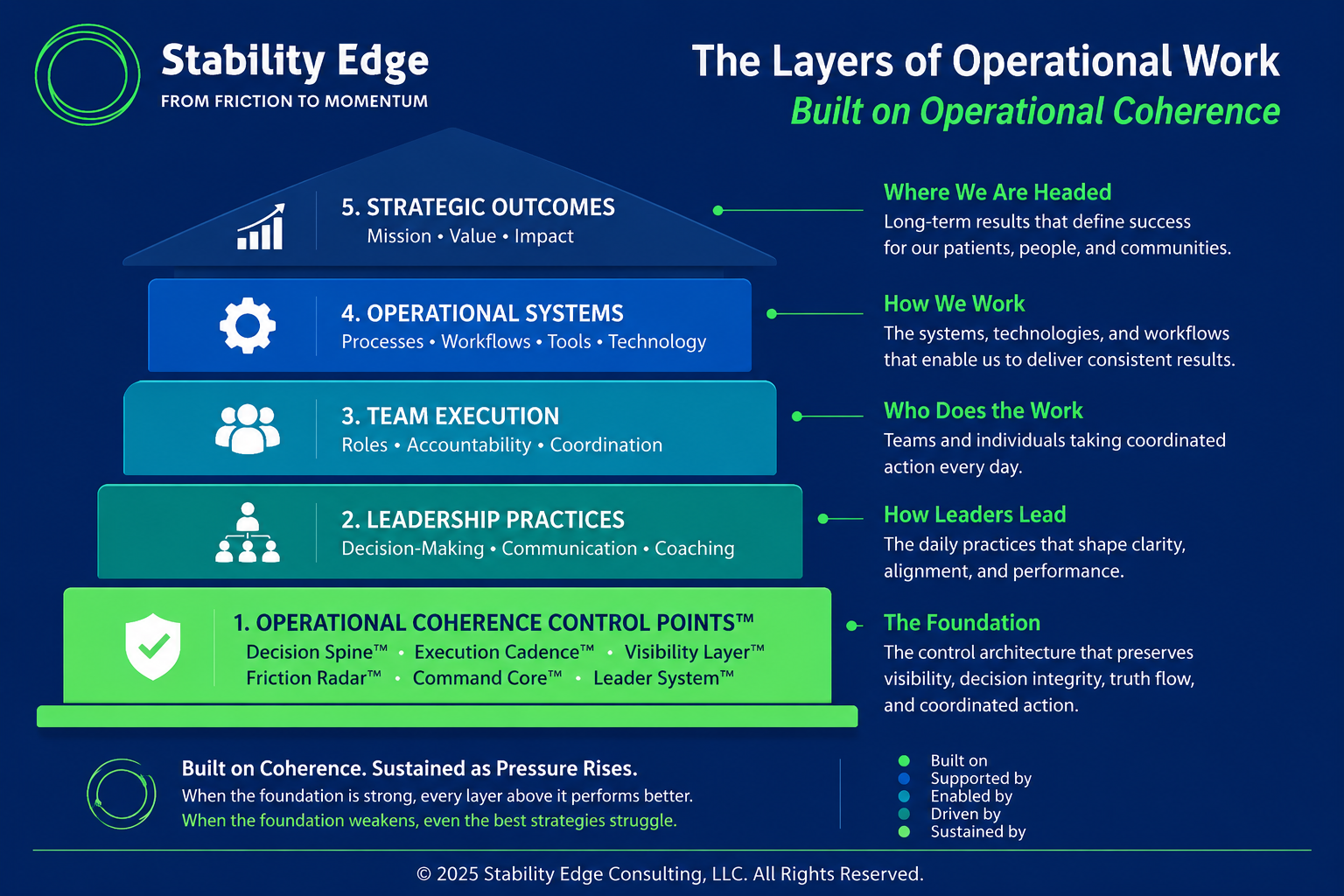
An implementation partner carries a specific, contracted scope. They build the configuration, migrate the data, run the testing cycles, and stand up the training. Their mandate ends at the point where the technology functions as designed.
The hardest part of a launch begins exactly where that scope ends.
In the stretch after the partner leaves, a leadership team must keep naming owners, closing decisions, and routing issues cleanly while its own attention narrows under strain. The scope purchased from a partner quietly defines the scope the organization must supply itself. Many leadership teams never notice they signed up for the second half.
The implementation team leaves. The contracted scope closes. And the ground no one owned becomes visible.
What Project Plans Measure vs. What Decides the Outcome
Project plans measure configuration completeness, training hours logged, and adoption rates. Those numbers matter. They also miss the variable that actually decides late outcomes.
Research on health IT implementation repeatedly identifies organizational conditions, including leadership, workflow, communication, and change management, as major determinants of results. The technology rarely breaks in isolation. People, processes, and the decisions that coordinate them can break first.
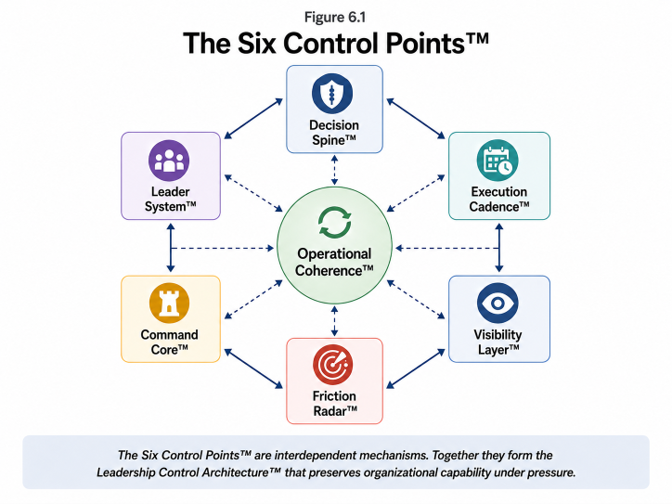
This is what decision endurance describes. It is the capacity of a leadership group to keep truth flowing and keep closing decisions after launch adrenaline fades and productivity pressure arrives. Post-EHR productivity declines have been documented across a range of settings. That operational reality creates pressure, and pressure exposes whatever leadership architecture was already thin.
What Disappears First When the Load Climbs
The honest way to stress-test any system is to ask what breaks first when pressure peaks. In a go-live, coordinated decision-making can go first.
Escalation paths that felt clear in the planning room turn ambiguous under real volume. Issues surface with no assigned owner. Executives step in personally to unstick each jam, one at a time.
That executive intervention looks like leadership. It is actually a signal that the architecture underneath has thinned. When heroics become the primary way decisions close, the system is already carrying more than its structure was built to hold. Raw effort is a different thing from a leadership team holding its decisions together under continuous load.
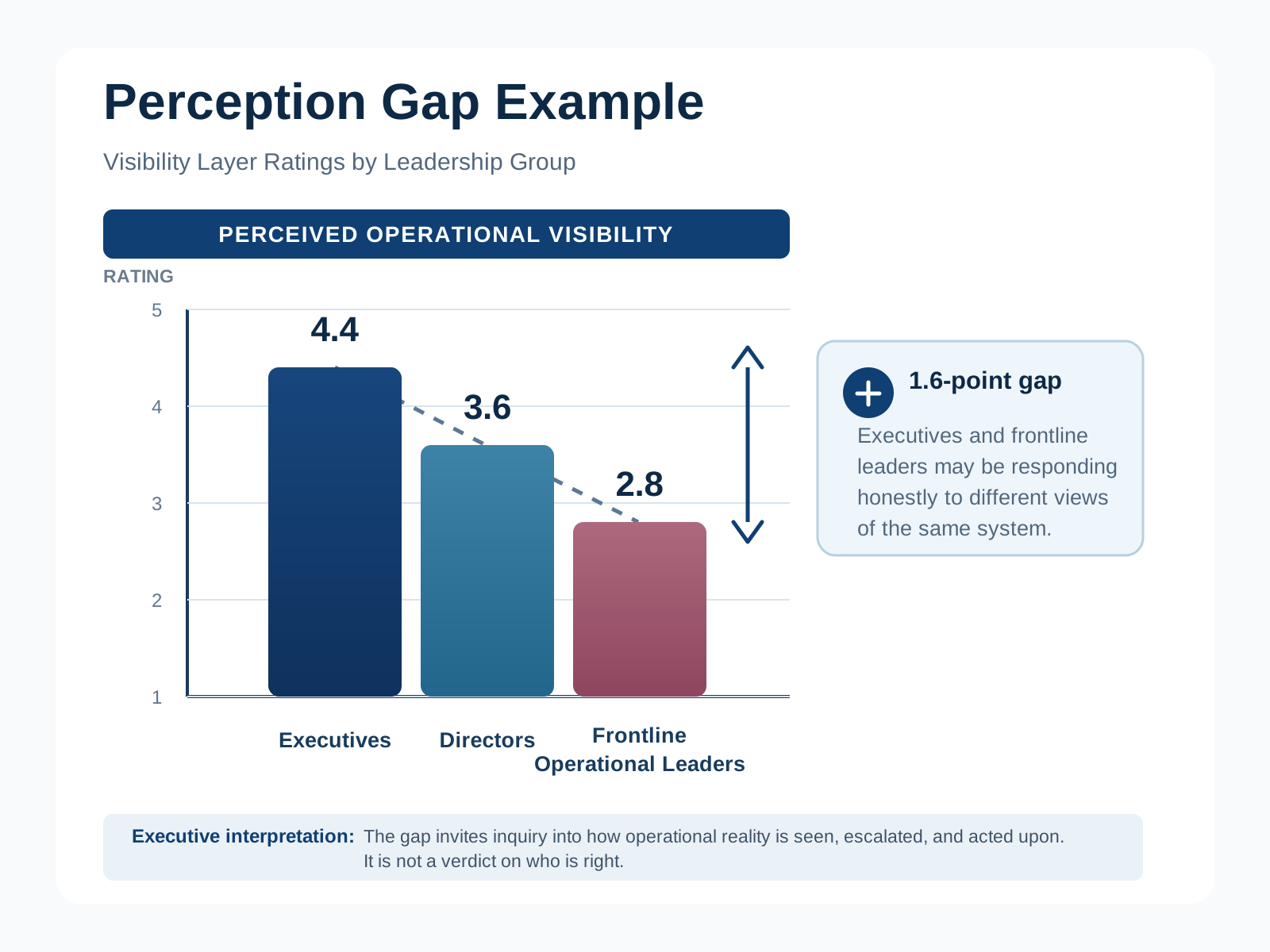
Leadership misalignment compounds the strain. When executives do not share the same picture of the project, that disconnection flows downward to project managers, slowing progress and seeding doubt across the organization. The floor reads that hesitation long before any dashboard registers it.
How Responsibility Quietly Changes Hands
Trace a live go-live issue and watch where responsibility moves.
The partner owns the fix until the technology works as configured. After that, ownership transfers to the internal team. The seam between those two zones rarely has a named catcher.
Issues that live in that seam, workflow misalignments, cross-department decisions, and judgment calls under pressure, fall to whoever happens to be available. It gets improvised, in real time, by tired people making individual calls.
Research on complex healthcare innovation makes the same point: outcomes vary widely when organizational change is required, and durable results depend on sustained leadership, aligned priorities, and post-launch coordination structures. That is the moment the uncontracted decision work matters most, and it is the exact moment the contracted help walks out the door.
Building the Half the Organization Has to Supply
Durability is a property of a leadership team's decision-making, not of the platform's configuration. A strong partner and well-trained users get an organization to a working system. Holding that system together in the pressured days after launch is work the organization has to supply itself.
That means naming decision owners before the pressure arrives, not during it. It means defining escalation paths that survive contact with real volume. It means treating workarounds and silence on the floor as intelligence, because operational reality reaches the clinical space long before it reaches executive reporting.
Change management deserves explicit investment. The next step is aiming part of that investment at leadership decision architecture, so coordination holds when attention is at its thinnest.
Key Takeaways
What to watch before launch
- Healthcare technology go-lives can lose ground after implementation, when contracted support closes and uncontracted leadership work begins.
- Organizational conditions, not technical readiness alone, determine whether the launch holds under sustained pressure.
- Decision endurance is the capacity to keep making clean decisions under load. It weakens quickly when it was not built before launch.
- Executive heroics are a warning signal. When individuals are manually closing decisions, the architecture underneath has already thinned.
- The seam between the partner's contracted scope and internal ownership is a high-risk zone that needs an explicit design.
- Workarounds and floor-level silence are intelligence. They reveal structural strain before any dashboard does.
- Organizations can improve post-launch stability by naming decision owners, defining real escalation paths, and investing in leadership decision architecture.
How Stability Edge Helps
Build the leadership half before pressure arrives.
Go-Live Readiness helps healthcare leadership teams clarify decision ownership, escalation discipline, command rhythm, and executive visibility before the hard weeks make those gaps expensive.
Explore Go-Live ReadinessTalk with MarkGet a Free 30-Minute Assessment CallFrequently Asked Questions
Questions leaders ask about this topic
Why do healthcare IT go-lives fail after launch rather than during implementation?
Implementation partners are contracted to deliver a functioning system. Once the technology works as designed, their scope closes. The leadership coordination work that sustains the system after launch is often underplanned and can lack a named owner or team.
What is decision endurance?
Decision endurance is the capacity of a leadership group to keep truth flowing and keep closing decisions cleanly after launch adrenaline fades, productivity drops, and organizational pressure peaks. It is a structural property of the leadership team, not a personality trait.
How much do RVUs typically drop after an EHR go-live?
The magnitude varies by organization, specialty, implementation approach, and time horizon. A productivity dip after go-live is common enough to plan for, which is why teams should prepare the leadership structure that will carry decisions during the recovery period.
What does leadership misalignment look like during a go-live?
When executives do not share the same picture of the project, that disconnection flows downward to project managers, slowing decisions and seeding doubt across the organization. Clinical teams and operational staff read that hesitation before it appears on any dashboard.
What percentage of healthcare IT projects fail to meet their original goals?
Published estimates vary because studies define success, project scope, and timeframes differently. The more useful planning conclusion is that organizational conditions, including leadership coordination, workflow, and change management, deserve the same rigor as technical readiness.
What does decision architecture mean in the context of a go-live?
Decision architecture refers to the named owners, escalation paths, and coordination mechanisms that determine how decisions get made and closed under pressure. It is the structural layer that determines whether thousands of people move as one system or fragment into individual workarounds.
What can organizations do before a go-live to improve post-launch stability?
Name decision owners before pressure arrives. Define escalation paths that can carry real volume. Treat workarounds and floor-level silence as intelligence rather than noise. Invest part of the change-management effort specifically in leadership decision architecture, not just user adoption.
Why do workarounds matter as a signal?
Workarounds accumulate where the system's structure does not match operational reality. They reveal weak points faster than dashboards do, because they show where people have stopped trusting the designed process and started improvising. Tracking them is one of the earliest available signals of structural strain.