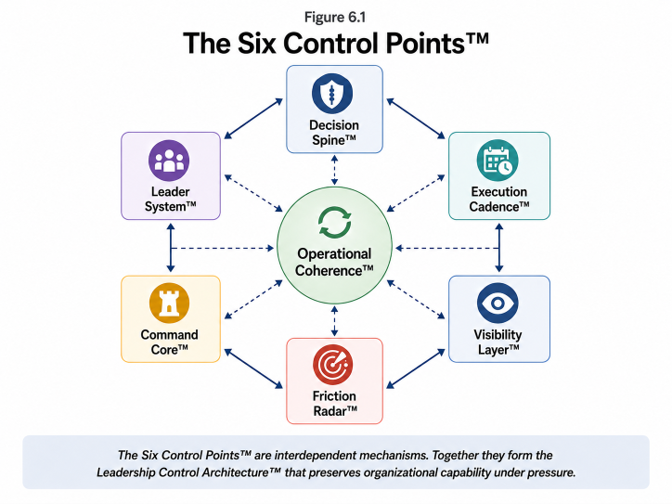
“I’m already juggling a bunch of balls: change management, quality, safety, patient experience, and Lean projects, plus working to practice leader standard work every day. How am I supposed to now practice something called ‘operational coherence’ using ‘six control points’ when I can’t even keep up as it is?”
Change management, quality, safety, patient experience, and leader standard work describe what the organization is trying to improve. The six control points describe how leaders coordinate, decide, execute, learn, and maintain control across all of those priorities.
Operational coherence should not become another program. It is the leadership infrastructure that keeps the existing programs from competing, duplicating work, and overwhelming leaders.
How the existing disciplines fit
Scroll the table horizontally to see all columns.
| Existing priority | What it contributes | How the six control points support it |
|---|---|---|
| Change management | Sponsorship, communication, readiness, adoption, and behavior change | Clarifies decisions, assigns sponsorship actions, surfaces adoption barriers, and coordinates responses. |
| Quality and safety | Risk reduction, standards, measurement, investigation, and improvement | Makes risks visible, accelerates escalation, assigns corrective-action decisions, and verifies implementation. |
| Patient experience | Understanding and improving the patient’s experience of care | Connects patient signals to operational decisions, owners, and measurable changes. |
| Lean | Standard work, visual management, waste reduction, and structured problem-solving | Provides methods that strengthen execution cadence, friction detection, and learning reviews. |
| Operational coherence | Integration of leadership activity across functions and priorities | Ensures all these disciplines work through one coordinated decision and execution system. |
There is overlap, especially with Lean management systems. That is not a problem. Where strong Lean routines already exist, use them. Do not install competing terminology or duplicate huddles, visual boards, A3s, or standard work.
The gap usually appears between the established systems.
- Quality identifies a safety concern, but no executive decision is made.
- Change management identifies resistance, but operational leaders do not change the implementation plan.
- Patient experience finds a recurring complaint, but several departments disagree about who owns it.
- Lean improves a process, but the required policy, staffing, or technology decision remains unresolved.
- Each function maintains its own dashboard, meetings, and action lists.
The six control points connect those pieces. See the six control points in more detail.
How each control point serves the existing priorities
Decision Spine
Makes sure quality, safety, change, Lean, and patient-experience findings become actual decisions.
For every significant issue, ask: What decision is required? Who decides? Who provides input? Who executes? Who verifies? Who records and communicates? By when?
Execution Cadence
Creates one leadership rhythm for reviewing the most important decisions, commitments, risks, and dependencies across all priorities.
The team does not need five separate status meetings. It needs one coordinated review of what requires leadership action.
Visibility Layer
Combines the few signals leaders need from quality, safety, patient experience, change readiness, operations, and finance.
It does not replace specialized dashboards. It pulls the most consequential findings into one executive view.
Friction Radar
Surfaces the workarounds, adoption barriers, patient pain points, standard-work failures, and operational burdens that formal metrics may miss.
This becomes a shared intake mechanism rather than separate listening systems that never connect.
Command Core
Brings the appropriate leaders together when an issue crosses clinical, operational, technical, financial, or workforce boundaries.
This is where competing priorities get resolved rather than pushed back down to project teams.
Leader System
Ensures leaders have the time, routines, tools, and delegation practices to support quality, safety, change, and improvement work without becoming overwhelmed or creating approval bottlenecks.
How it creates more time rather than consuming more time
The first design principle: no net new meeting burden. Replace and consolidate before adding anything.
The structure creates capacity in six practical ways.
- Replace status reporting with decision work. Written updates are circulated beforehand. Meeting time is used only for decisions, risks, cross-functional dependencies, commitments that are slipping, and lessons requiring a change.
- Use one decision record. Quality, safety, change, and operational teams should not maintain separate versions of the same unresolved issue. One decision record identifies the decider, executor, verifier, communicator, deadlines, and dependent work.
- Create one escalation path. People should not have to determine whether an issue belongs in the quality meeting, transformation steering committee, operational review, or executive meeting. The escalation criteria determine where it goes.
- Consolidate overlapping reviews. Instead of separate meetings reviewing similar risks and actions, combine the leadership portion into an integrated operating review. Specialized teams can continue doing detailed technical work. Executive coordination happens once.
- Prevent repeated discussion. A documented decision does not need to be rediscovered, reinterpreted, and debated at three later meetings. Clear recording and communication reduce reopened decisions.
- Address recurring friction at the source. Leaders often lose time repeatedly resolving the same exception. Friction Radar identifies the missing rule, ownership, standard work, or system change causing the repeat problem.
How you propose it in your organization
Do not lead with: “I want to introduce six new control points.”
That sounds like another framework, another initiative, and more work. Lead with the coordination burden they already experience.
You already have important systems for quality, safety, patient experience, change management, and Lean improvement. I am not proposing that you replace or duplicate any of them.
The opportunity is to strengthen the leadership operating structure that connects them.
When several priorities are moving simultaneously, decisions can wait, issues can move between committees, departments can work from different assumptions, and leaders can spend increasing amounts of time in meetings without achieving closure.
The Leadership Control Architecture provides one practical structure for identifying decisions, assigning accountability, coordinating execution, surfacing operational friction, and learning from results.
The goal is not to add more meetings or reporting. The goal is to consolidate leadership work, shorten the time between issue identification and action, reduce repeated escalation, and create more leadership capacity for quality, safety, patient experience, change, and improvement.
A low-risk way to introduce it
Do not propose an enterprise-wide rollout initially. Apply it to one existing priority that is already experiencing coordination strain.
For example:
- An EHR implementation
- A patient-flow initiative
- A quality or safety corrective-action plan
- A centralized scheduling transformation
- A patient-experience improvement effort
- A major Lean redesign
For six weeks:
- Identify the major decisions and dependencies.
- Install the complete decision record.
- Restructure one existing leadership meeting.
- Create one shared view of risks, friction, and commitments.
- Conduct brief learning reviews after significant events.
- Remove redundant reports and meetings.
Then measure whether the structure produced:
- Faster decision closure
- Fewer repeated escalations
- Fewer reopened decisions
- Less duplicate reporting
- Fewer unresolved cross-functional issues
- Reduced meeting time
- Better completion of quality, safety, change, and improvement commitments
Who practices operational coherence?
Leaders use operational coherence practices to lead all of the work improvement priorities: change management, quality, safety, patient experience, and leader standard work. They name and close decisions, coordinate execution, maintain a clear view of reality, surface friction early, resolve cross-functional issues, and protect leadership capacity and learning.
These are leadership responsibilities.
The Stability Architect
The Stability Architect is the coach, designer, and observer. They help leaders see where their operating practices are weak; teach practical routines for each control point; facilitate the initial installation of those routines; observe meetings and decision practices; provide feedback and coaching; help simplify or redesign tools, roles, and operating rhythms; track whether leadership practice is improving; and gradually step back as leaders become competent.
Leaders practice operational coherence. The Stability Architect helps them learn, strengthen, and sustain that practice.
Or even more simply: The leader is the player. The Stability Architect is the coach.
This clarifies how change management, quality, safety, patient experience, and Lean fit. The leader uses operational coherence practices to lead all those priorities. The Stability Architect does not have those priorities and does not run the six control points for the leader. The Stability Architect supports and enables the leader to operate them effectively.
Explore how Leadership Control Architecture supports Operational Coherence™, or see the Stability Architecture Advisory.
How Stability Edge Helps
Turn the pattern into a practical operating response.
Stability Edge helps healthcare executive teams connect leadership experience with local operating evidence, identify the control points under strain, and establish focused actions that can be reviewed through the recovery period. The work is designed to create a usable shared view, not another report that sits on a shelf.
Talk with MarkGet a Free 30-Minute Assessment CallFrequently Asked Questions
Questions leaders ask about this topic
How are you going to help me lead my upcoming EHR implementation?
We begin with the implementation work already in front of you: the decisions that must close, the dependencies that cross teams, the risks that require escalation, and the operating signals leaders need to see. The six control points then help your leadership team establish a practical decision rhythm, clarify accountability, surface friction early, and verify follow-through without creating a parallel program.
Why is this any better than what I am currently doing with my existing network of vendors and consultants?
Vendors and consultants can bring essential technical, clinical, change, or project expertise. Operational coherence does not compete with that work. It gives the leadership team a shared operating structure for connecting those contributions, resolving cross-functional decisions, and making sure important issues do not stall between workstreams, committees, or dashboards.
You have fancy diagrams and big words. What about dialed-in results?
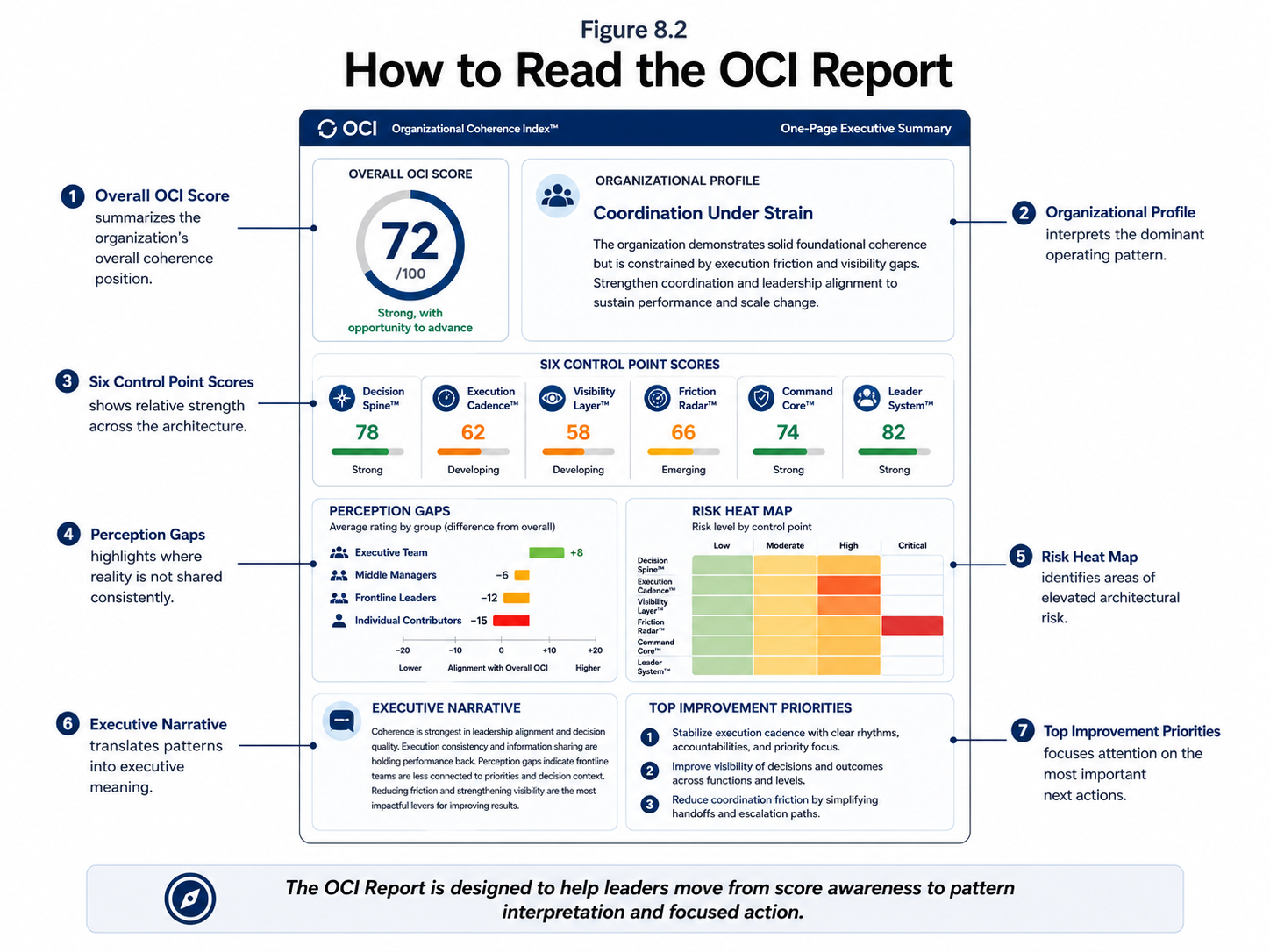
The diagrams are useful only if they improve the work. Leaders define the operational results that matter for the priority at hand, then use the two measurement instruments to examine both leadership experience and the results the work achieves. A focused pilot tests whether decision closure is faster, repeated escalations decline, meeting burden falls, cross-functional issues resolve, and quality, safety, change, and improvement commitments are completed more reliably.